
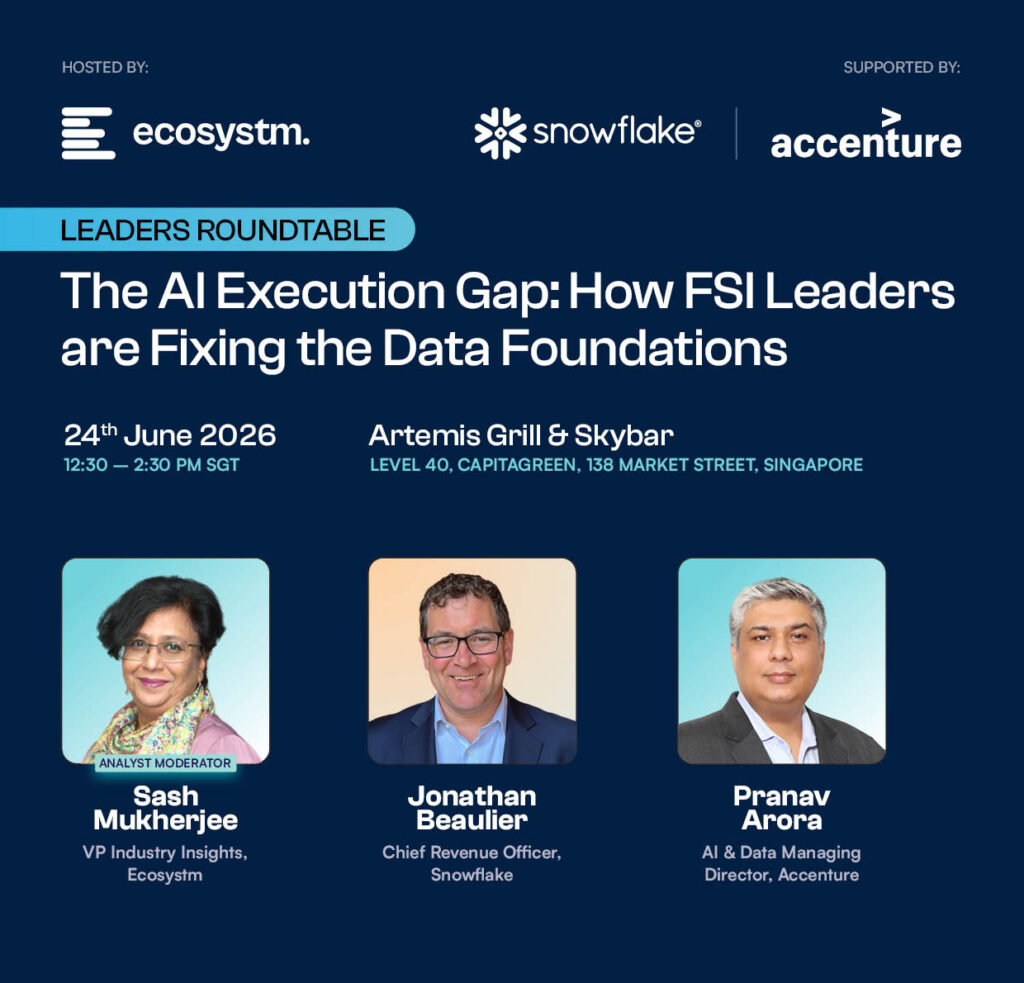
Financial services organisations in Singapore are moving quickly to operationalise AI. But leaders face a consistent set of constraints: legacy data estates that are hard to modernise, siloed architectures, governance models not designed for AI, and regulatory scrutiny that adds friction at every layer. The result: deployments remain concentrated in internal productivity use cases, with limited adoption in customer-facing applications beyond narrow service automation.
Ecosystm research confirms the pattern:
- Only 21% of FSI leaders express confidence in their data strategy
- 70% cite governance and compliance as a key barrier
- 60% are still working through how to make data reliably accessible for AI use
Addressing this requires a shift in how data is organised and governed, enabling it to be accessed consistently, used safely across structured and unstructured sources, and connected into AI workflows without creating additional fragmentation. It requires a foundation where data is AI-ready by design, not retrofitted through layers of integration and exception handling.
Join us for a candid, off-the-record Ecosystm Leaders Roundtable, where senior peers and regional technology experts work through the real constraints shaping AI adoption today and the decisions that matter next.
The discussion will cover:
- Best practice lens. Global and regional perspectives on how financial institutions are evolving data strategy, governance, and AI operating models
- Operating model gaps. Where alignment between business, technology, and risk breaks down, and what is improving execution at leadership level
- Regulatory trade-offs. How institutions are managing regulatory scrutiny while maintaining delivery velocity in AI adoption
- Ecosystem decisions. The factors shaping high-stakes build vs. buy vs. partner choices in a rapidly evolving AI ecosystem
- Value realisation shift. How data investment is being reframed from infrastructure spend to a driver of revenue and margin growth
Plus: Attendees receive a standing invitation to a complimentary, tailored data strategy session with the Snowflake x Accenture FSI leadership team.

Snowflake
Snowflake is a cloud-based data platform and data warehouse that enables organizations to store, process, and analyze large volumes of data.

Accenture
Accenture is a leading global professional services company known for providing strategy, consulting, digital, technology, and operations services. It is particularly recognized for large-scale enterprise digital transformation, cloud computing, artificial intelligence (AI), and IT implementation for Fortune 500 companies and governments worldwide.

Sash Mukherjee
VP Industry Insights,
Ecosystm

Jonathan Beaulier
Chief Revenue Officer, Snowflake
Register for this Event


