








1. AI is Moving Across the Telecom Stack
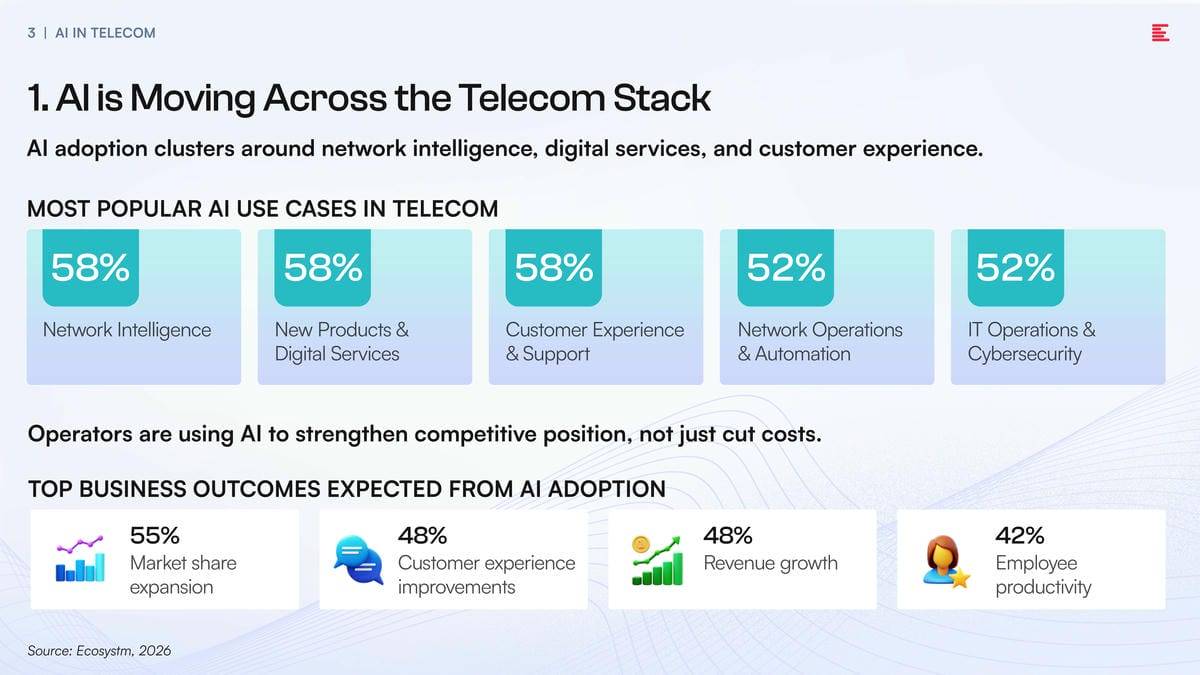
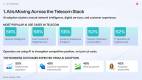
AI adoption in telecom is not being driven by a single use case. The strongest concentration sits across network intelligence, digital services, and customer experience, putting AI close to two things operators care about most: understanding network and customer behaviour, and finding ways to differentiate the service.
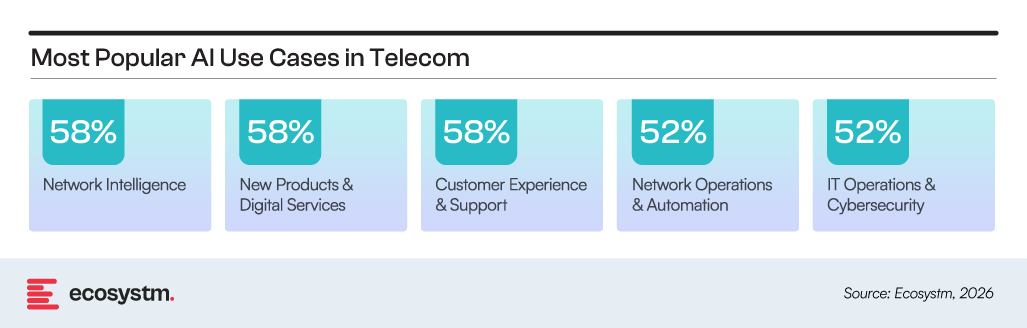
What stands out is the absence of a gap between commercial and operational applications. AI is already being used to influence both the service customers receive and the infrastructure required to deliver it. Improvements in one can quickly affect the other: better network intelligence can inform service design, while better digital services generate new data and interaction points.
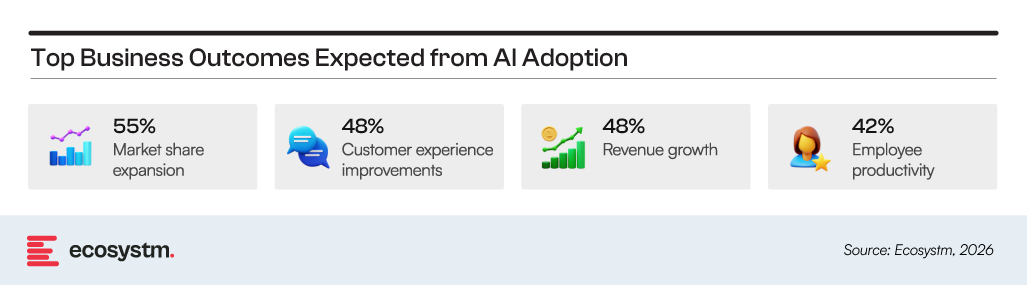
The business priorities reinforce this. Market share is the leading outcome, ahead of cost reduction, with customer experience and revenue also prominent. Operators are therefore looking to AI to strengthen the top line and competitive position, not simply to automate existing work.
But the more important shift is where these capabilities are being embedded. As AI moves into OSS, BSS, and network management, it starts to influence the systems that run services and networks directly.
2. AI Enters the Core
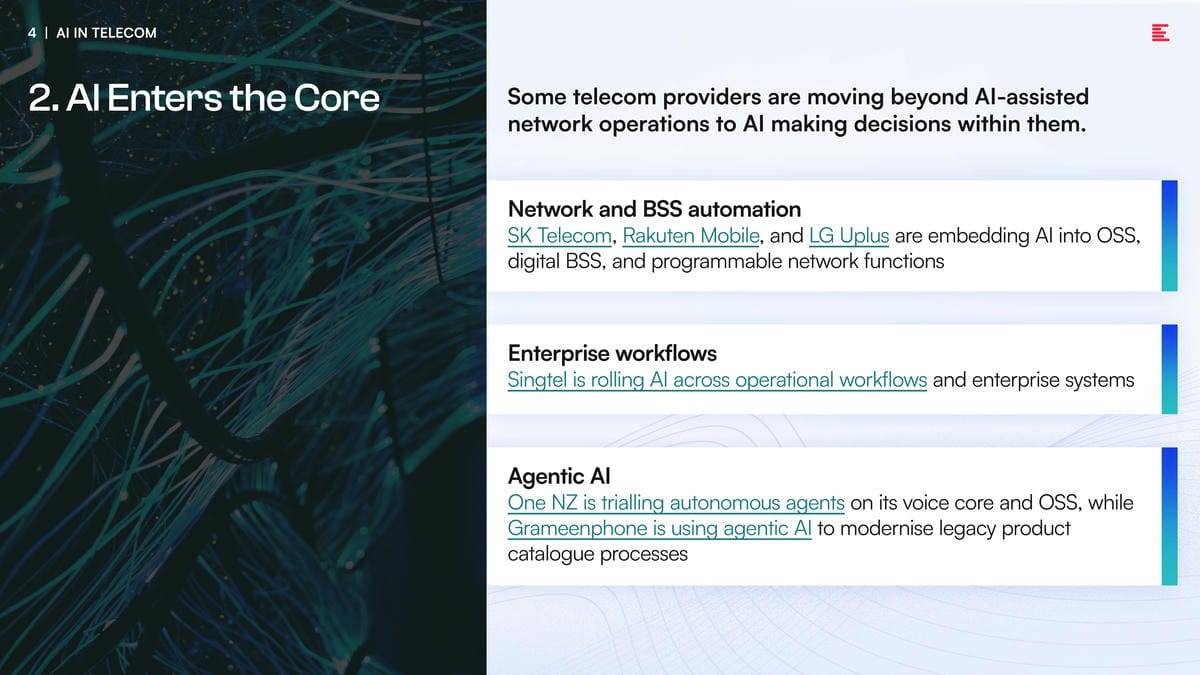
This is the next stage of adoption: AI participating in network operations, rather than simply supporting them.
SK Telecom is working towards Level 4 autonomous networking through its next-generation OSS and integrated data architecture. Rakuten Mobile is embedding AI into its digital BSS, while LG Uplus is applying AI to network automation and programmable network functions. Singtel is extending AI across operational workflows and enterprise systems.
Agentic AI takes this further. One NZ is trialling autonomous agents across its voice core and OSS environment that can identify network problems and take corrective action, while Grameenphone is applying agentic AI to modernise legacy product catalogue processes.
The Tokyo Accord, signed by leading Japanese operators, reinforces the move towards AI-native 6G and AI-RAN, including the potential for operators to become distributed AI compute providers.
Once AI can influence or act within network systems, the architecture around it matters much more. Data access, infrastructure ownership, vendor dependencies, and regulatory jurisdiction can all determine what AI is able to do.
3. Regulation Is the Brake
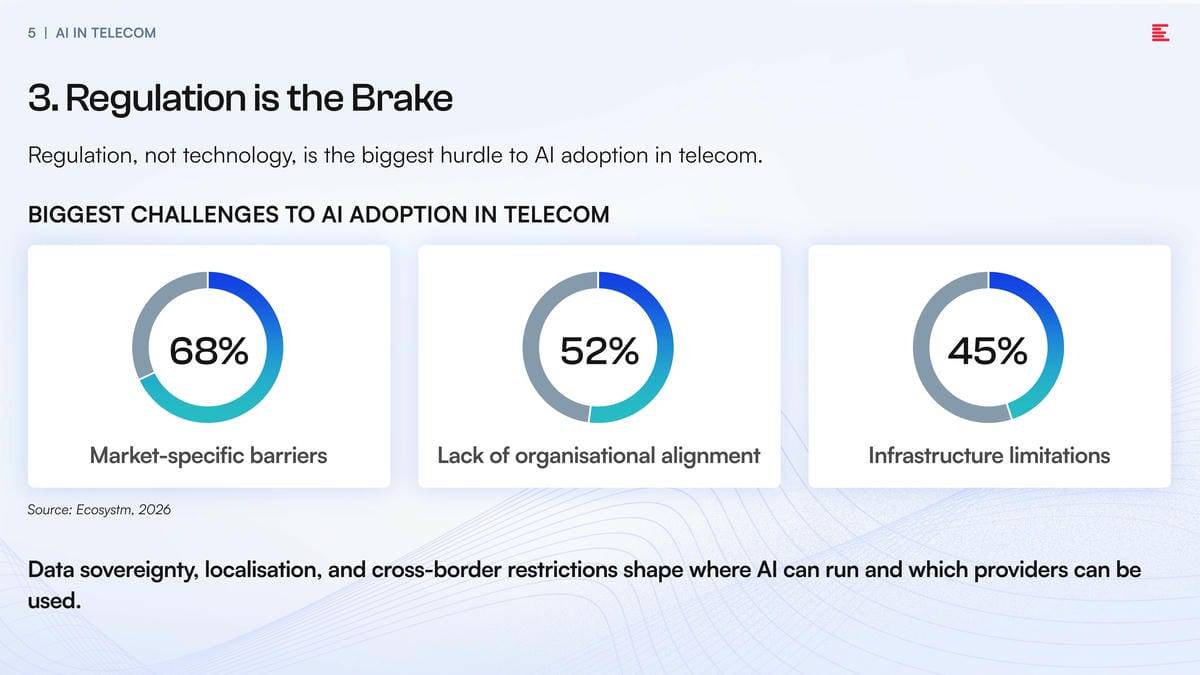
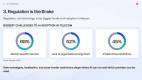
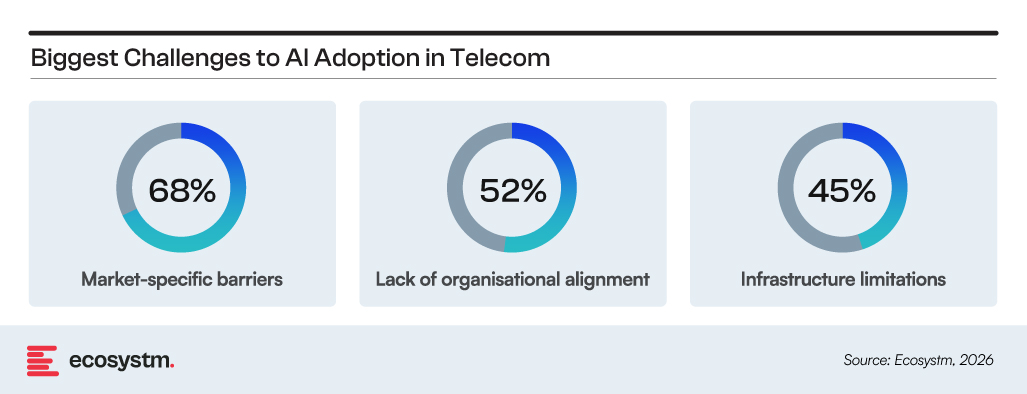
Market-specific barriers stand out as the biggest constraint on AI adoption in telecom. This reflects the sector’s exposure to national regulation and the practical difficulty of applying AI across markets with different requirements.
Operators may need to account for data sovereignty, localisation, cybersecurity, critical infrastructure requirements, and restrictions on cross-border data flows. These requirements can affect where data is stored, where AI workloads can run, which models can be used, and which technology providers can participate.
The challenge becomes more material as AI moves into network operations. An AI model supporting customer service can operate within a relatively contained environment. An AI system making decisions about routing, capacity, service quality, or network resilience is much harder to separate from the regulated infrastructure itself.
This also means regulatory requirements can influence technology architecture from the outset, rather than being addressed after an AI system has been designed.
Regulation is therefore becoming an architectural constraint, not simply a compliance requirement.
4. Sovereignty Moves into Infrastructure
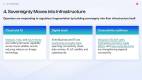
The response to regulatory fragmentation is extending into the infrastructure itself.
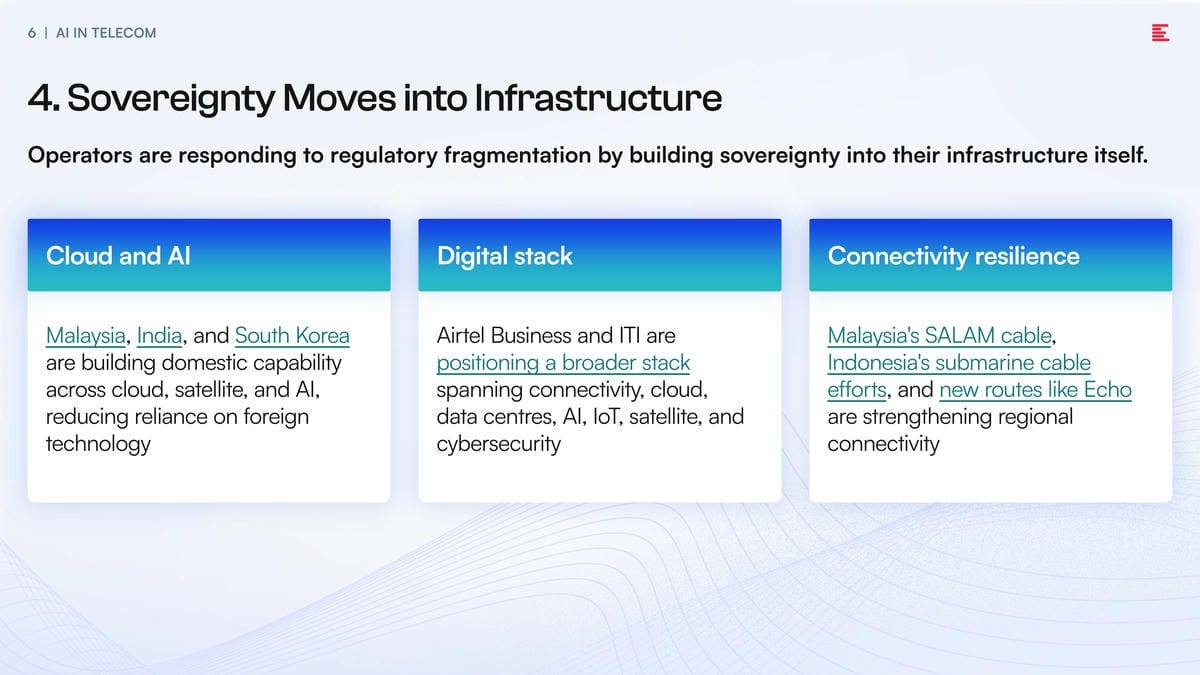
Malaysia is considering a sovereign cloud framework to protect sensitive government and personal data. India is evaluating sovereign LEO satellite infrastructure while expanding BharatNet, with more than 221,000 local village councils reported as service-ready. Airtel Business and ITI are also positioning their partnership around a broader sovereign digital stack spanning connectivity, cloud, data centres, AI, IoT, satellite connectivity, and cybersecurity.
South Korea’s national AI initiative similarly puts SK Telecom, KT, and Kakao at the centre of efforts to build domestic AI capability and reduce dependence on foreign technology.
The same considerations are extending to connectivity. Malaysia’s planned SALAM submarine cable is intended to strengthen domestic transmission capacity, while Indonesia is addressing submarine cable resilience to fulfill its ambitions of expanding its digital economy by 2045. Additional international routes such as Echo are also adding connectivity resilience.
These initiatives differ in scope and purpose. Some are explicitly about sovereignty; others address resilience, capacity, or national connectivity. The common thread is that infrastructure supporting critical digital services is becoming a strategic consideration in its own right.
For telecom operators, that can affect where infrastructure is located, how data moves, which networks and cloud environments are used, and which technology partners can be relied upon. Sovereignty is therefore becoming part of infrastructure planning, alongside performance, cost, and resilience.
5. Scale Becomes Strategic
AI-native networks and sovereign infrastructure require investment across compute, data centres, connectivity, spectrum, cloud-native platforms, and network resilience. For operators, that puts greater weight on scale, partnerships, infrastructure sharing, and access to capital.
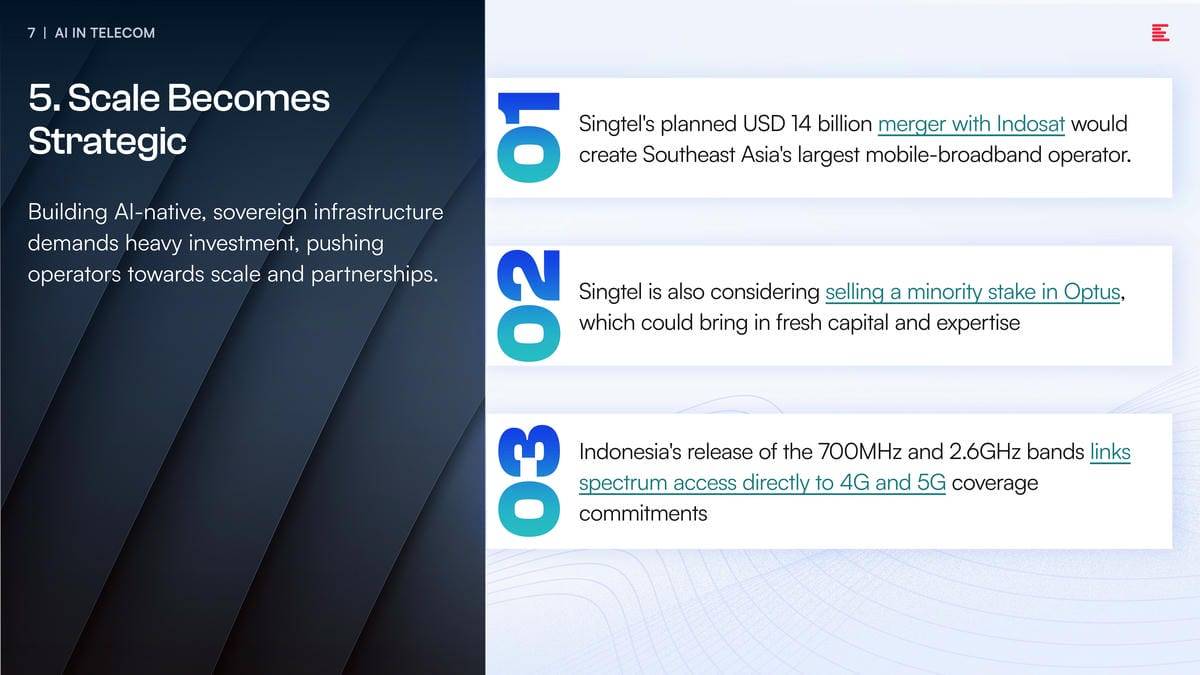
Singtel’s planned USD 14 billion combination with Indosat would create Southeast Asia’s largest mobile-broadband operator, with infrastructure rationalisation and cost synergies forming part of the rationale. Singtel is also exploring a minority stake sale in Optus, potentially bringing additional capital and expertise into the Australian operator.
Spectrum policy is part of this broader picture. Indonesia’s release of the 700MHz and 2.6GHz bands links access to spectrum with commitments to expand 4G and 5G coverage, connecting scarce network resources with national connectivity objectives.
As the cost and complexity of telecom infrastructure grows, operators have more reasons to consider where scale genuinely creates an advantage, where partnerships make more sense, and which assets need to be owned or shared. AI and sovereignty are adding new considerations to decisions about network investment and industry structure.