






1. AI Competitiveness is Driving Investment in National Capabilities
Governments across Asia Pacific are treating AI as a long-term national capability rather than a standalone technology initiative. Alongside AI applications, investment is being directed towards the foundations that enable AI at scale, including compute infrastructure, data, talent, research, and digital institutions.
Ecosystm research highlights why these investments matter.
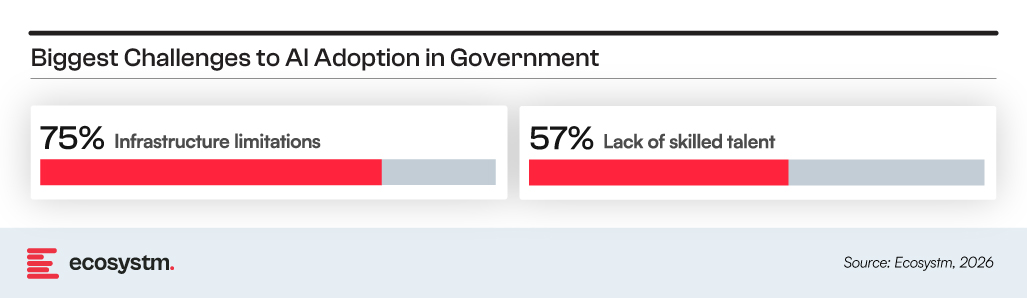
Infrastructure and talent are the two biggest barriers to wider AI adoption. Across the region, governments are responding with long-term investments.
India is expanding national compute capacity under the IndiaAI Mission with 20,000 GPUs to strengthen sovereign AI infrastructure, while Singapore continues to invest in AI research, high-performance computing, and talent development. At the same time, governments are accelerating efforts to build AI-ready workforces. Malaysia’s Ministry of Human Resources is partnering with industry to provide free AI training to more than 22,000 Malaysians, and South Korea’s Ministry of Science and ICT is offering up to USD 1.3M annually to attract leading global AI researchers.
2. AI Is Being Evaluated Beyond Technology Adoption
As AI adoption expands across the public sector, governments are placing greater emphasis on the outcomes it delivers rather than the technology itself. Success is increasingly being measured across operational performance, service delivery, workforce adoption, and governance, reflecting a broader view of AI as an organisational capability rather than a standalone digital initiative.
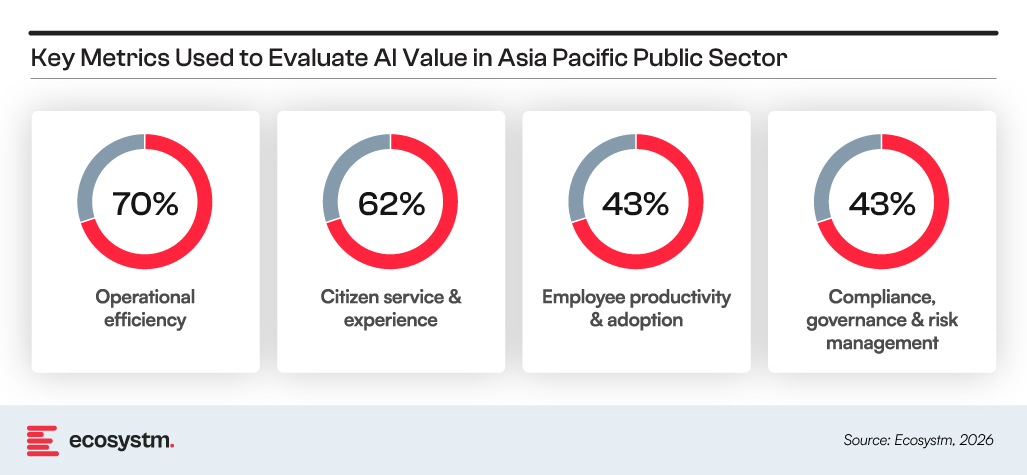
Governments are increasingly pursuing two clear objectives simultaneously: improving the way public institutions operate and enhancing the services they deliver to citizens.
3. AI Is Becoming Part of Everyday Work
AI is being built into the way public sector agencies operate. Rather than confining AI to citizen-facing services or standalone automation projects, organisations are embedding it into everyday workflows to support tasks such as drafting reports, analysing documents, writing code, scheduling work, conducting research, and managing knowledge. The focus is on helping employees work more effectively while maintaining appropriate oversight and accountability.
Several governments taking similar approaches. In Singapore, GovTech’s AI Assistant Desk aims to provide every government employee with a secure personal AI assistant capable of supporting report writing, coding, and scheduling. Complementing this is an AI Agent Registry that provides visibility into AI agents operating across government, helping agencies manage ownership, activity, and governance as adoption expands. Japan’s Digital Agency is expanding its Gennai generative AI platform to around 180,000 officials across ministries, making it one of the world’s largest public sector GenAI deployments. Similarly, the Philippines is rolling out Gemini Enterprise to more than 50,000 public sector employees, integrating AI into administrative work while embedding it within platforms such as the national e-procurement system.
4. AI Is Reshaping Citizen Service Delivery
Beyond workforce productivity, government agencies are also applying AI to improve how citizen services are delivered and operational decisions are made. AI is being used to streamline approvals, improve regulatory processes, strengthen border security, and enable organisations to respond more quickly and consistently to citizens’ needs. Rather than simply digitising existing services, organisations are redesigning processes around AI-enabled decision support and automation.
Hong Kong plans to introduce AI across 200 public service procedures by 2027, spanning customer enquiries, licensing, approvals, and data analysis. In Indonesia, the INAku platform is simplifying access to thousands of government services by integrating digital identity with secure cross-agency data exchange, reducing fragmentation across agencies. Meanwhile, the Philippines is evaluating an AI-enabled border management system that combines biometrics with real-time risk analysis across airports, seaports, and land crossings to improve both security and passenger experience.
5. Shared Platforms Are Accelerating AI Adoption
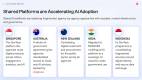
Shared AI platforms are replacing fragmented, organisation-by-organisation approaches to AI deployment. Common platforms reduce duplication, improve interoperability, and provide organisations with access to trusted infrastructure, tools, and governance frameworks that can be reused across the public sector.
GovTech has introduced a platform that enables agencies to discover and reuse government-developed digital products spanning citizen relationship management, analytics, and AI capabilities. Australia has established a whole-of-government technology agreement that provides public sector organisations with standardised access to cloud infrastructure, AI services, and productivity tools under common commercial and security arrangements, while AI.gov.au centralises AI guidance, implementation resources and case studies. Similar approaches are emerging elsewhere. New Zealand has centralised digital investment and delivery through a dedicated government agency; India has migrated BHASHINI, its public multilingual AI platform, to a sovereign AI cloud to provide government agencies access to shared language AI capabilities; while Indonesia’s GovTech programme is consolidating fragmented digital services into common platforms centred around digital identity and secure data exchange.
6. Governance, Security & Trust Are Becoming Operational Capabilities
As AI becomes embedded across public sector operations, governance and security are evolving alongside it. Public sector organisations are moving beyond high-level principles to establish the policies, oversight, and security measures needed to deploy AI safely across critical public services.
South Korea has established a dedicated AI Safety Institute to evaluate advanced AI models and strengthen national AI governance. Japan has introduced legislation requiring developers of advanced AI systems to cooperate with government safety assessments and report serious AI-related risks. New Zealand is rolling out government-wide guidance and mandatory governance practices to help agencies adopt GenAI responsibly, supported by AI capability building for public servants. At the regional level, ASEAN has established an AI Safety Network and introduced a common AI testing and benchmarking framework, enabling organisations to evaluate AI systems against shared regional standards.
Ecosystm Opinion

“The story of AI in government is not about the latest pilot or experiment; it is about delivering measurable public value wherever AI is embedded, whether in services or internal workflows. Across the region, AI is becoming part of how governments operate, how public services are redesigned, and how capability is strengthened across the public sector. Governments are approaching AI with a stronger focus on governance, implementation, and outcomes for employees, citizens, and industry.”