






Indonesia is building the foundations for AI, spanning connectivity, data centre capacity, governance frameworks, and talent across a geographically complex and rapidly digitising economy. There are all the necessary national-scale investments countries need to make today, but they do not automatically translate into enterprise adoption of AI today.
For enterprises, maturity is defined by how effectively and quickly they convert growing national capability into operational strategy, measurable value, scalable systems, and reliable deployment.


1. AI Is Not Embedded in Business Strategy Yet
AI is being managed as an activity, not a direction, which limits its influence on operating models and investment decisions.
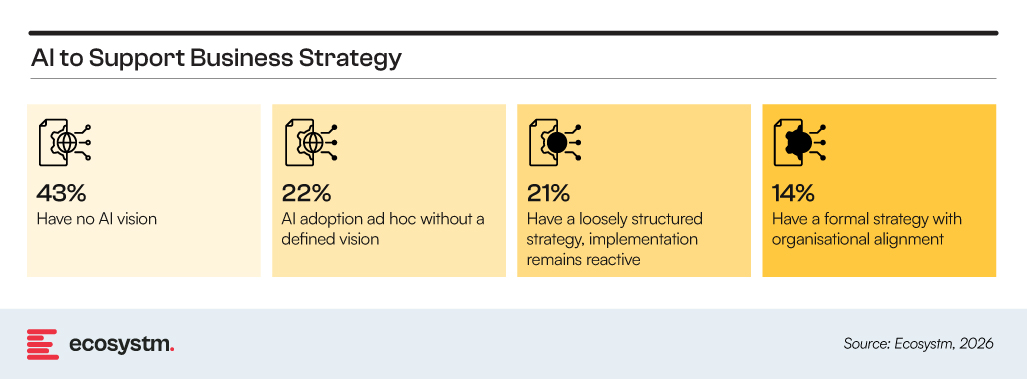
Organisations need to embed AI into core business planning by anchoring it to a small set of enterprise outcomes (growth, risk, customer, and efficiency) with clear executive ownership across business and technology teams.
2. AI Is Constrained by Delivery Conditions
Scaling AI is being slowed by the inability to consistently fund, support, and operationalise it across the organisation.
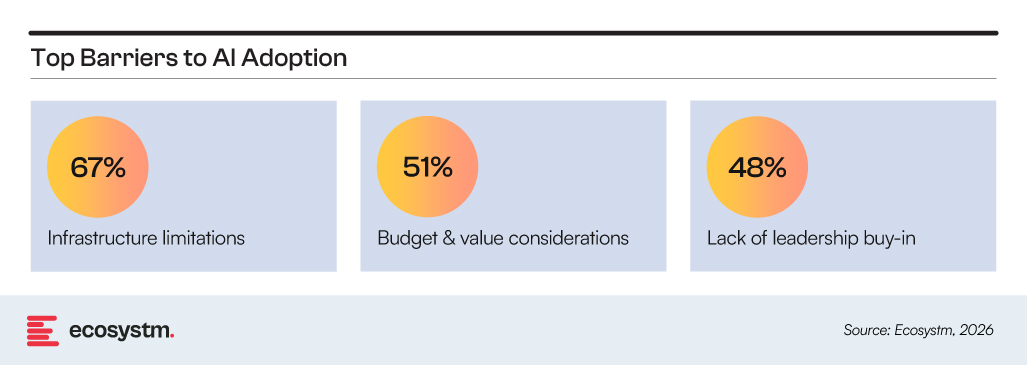
AI should be managed as a portfolio of outcome-linked investments, supported by shared infrastructure and governed through joint business–technology accountability for delivery performance.
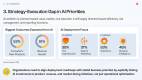
3. Strategy-Execution Gap in AI Priorities
AI ambition is oriented toward value creation, but execution is still largely directed toward efficiency, risk management, and reporting functions.
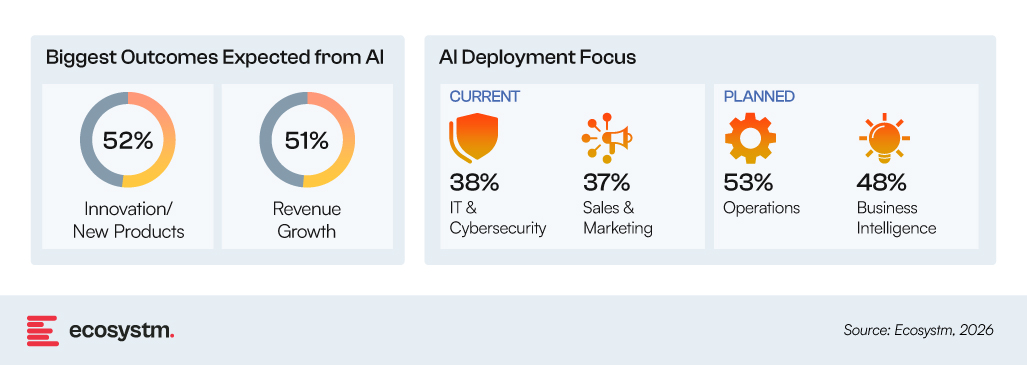
Organisations need to align deployment roadmaps with stated business priorities by explicitly linking AI investments to product, revenue, and market-facing initiatives, not just operational optimisation.
4. Governance Maturity Is Not Keeping Pace with AI Adoption
Governance is being retrofitted onto AI adoption, not designed alongside it, creating gaps between policy and how systems actually behave in production.
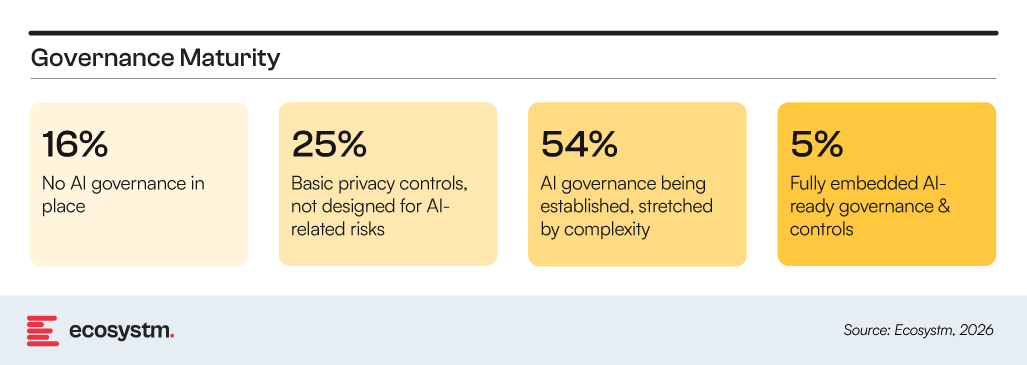
Organisations must embed controls such as access rules, audit trails, and data permissions directly into AI and data platforms, so governance is enforced through system design rather than separate review processes.
5. Data Consistency Remains a Structural Weak Point
Data pipelines are not yet functioning as a coherent infrastructure layer, but as disconnected processes across environments, limiting reliability for real-time and AI-driven workloads.
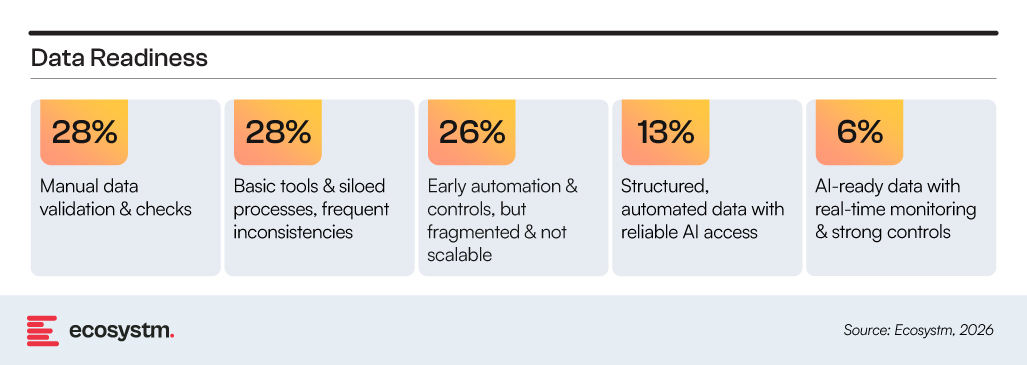
Organisations should first standardise data flows across core systems and put in place baseline automated validation, before building advanced AI use cases on top of them.
6. AI Talent Depth Remains Uneven
AI work is carried out by a narrow base of specialists, making delivery dependent on a few teams rather than being distributed across the organisation.
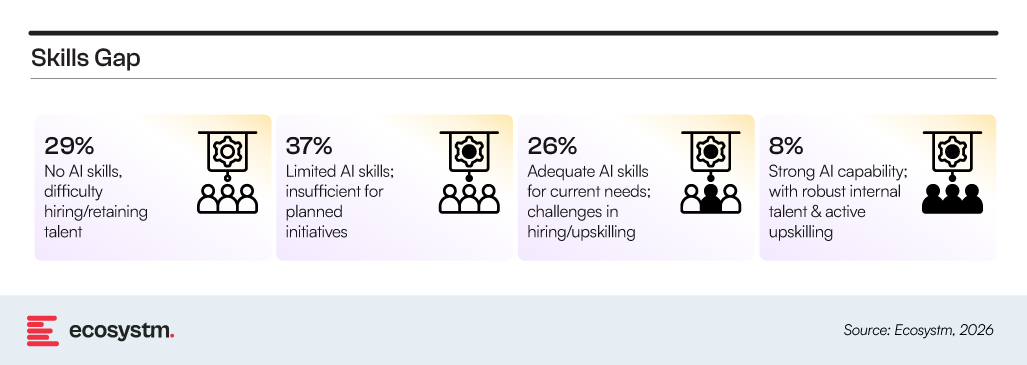
Organisations need to build AI capability into business teams through structured upskilling and shared delivery models, rather than relying solely on centralised specialist hiring.

Ecosystm Opinion
Indonesia is strengthening its national AI foundations, but enterprise readiness is still uneven across strategy, infrastructure, data, governance, and skills. The real test ahead is how quickly organisations turn these capabilities into day-to-day operating models where AI is embedded across processes and decisions, rather than deployed as isolated use cases.
- Where are banks using AI today
Most production use is in onboarding, fraud detection, employee productivity tools, customer analytics, and operational risk monitoring rather than standalone “new AI products”.
- Why is onboarding a big focus if banks are already digital?
Because identity verification, fraud checks, and compliance requirements still sit behind most onboarding journeys and remain expensive and manual to scale.
- What AI use cases are banks prioritising first?
Banks tend to start with internal productivity, fraud detection, and onboarding improvements because they are easier to integrate and show measurable operational impact.
- What is stopping banks from scaling AI beyond pilots?
It usually comes down to regulatory approval cycles, fragmented or poor-quality data, cost of integration with legacy systems, and shortage of experienced talent.
- Is regulation the main reason AI adoption is slow in banking?
It’s less about slowing adoption and more about shaping which use cases move first—especially those with clearer governance and auditability.
- How are banks dealing with data privacy issues when using AI?
By restricting AI to controlled datasets, strengthening internal governance, and prioritising use cases where data lineage and access controls are already mature.
- What does “agentic AI” actually mean in a banking context?
It refers to AI systems that can take actions within defined rules—like flagging fraud patterns, triggering alerts, or executing parts of a workflow such as payment validation.
- Are banks really letting AI take actions on transactions?
In limited and controlled environments, yes—mainly for fraud detection, transaction monitoring, and assisted decisioning rather than fully autonomous financial decisions.
- How are regulators reacting to AI being used in core banking processes?
They are focusing on governance expectations, customer transparency, auditability, and ensuring customers know when AI systems are interacting with their accounts or transactions.
- What is changing in cross-border payments now?
Banks and payment systems are connecting real-time rails, QR systems, and settlement networks, with early exploration of tokenised and stablecoin-based settlement models.
- Are stablecoins being used in banking yet?
They are still early-stage but moving through licensing, pilot programs, and regulatory frameworks rather than remaining purely conceptual.
- Why is climate risk discussed in banking strategy meetings?
Because it directly affects lending risk, capital allocation, regulatory compliance, and portfolio exposure—especially in climate-sensitive markets across the region.
- What does climate risk look like in day-to-day banking operations?
It shows up in credit assessments, lending decisions, stress testing, and emerging requirements for transition planning and disclosure.
- What will separate leading banks from others over the next few years?
It will be their ability to connect AI, data, and infrastructure in a way that works reliably inside regulated environments—not just deploying individual use cases.