Banks in Asia Pacific are facing simultaneous pressure on speed, cost, resilience, and compliance, all while operating in an environment where risk is becoming more distributed and more immediate.
That pressure is reshaping how transformation is being approached across the sector. What began largely as programmes to digitise channels and improve customer experience is increasingly extending into the operating core: how decisions are made, how risk is identified and acted on, how data moves across the organisation, and how trust is sustained in systems where activity is more connected, automated, and real-time by design.
Across Asia Pacific, the direction of change is broadly consistent, even if the pace of execution varies by institution and regulatory context. Banking is being rebuilt through incremental but material changes in infrastructure, governance, operating models, and product architecture.
The five trends below highlight where these changes are becoming most visible.
1. Efficiency, Risk, and Customer Experience Drive Banking AI
The most widely adopted AI use cases in banking are concentrated around areas where institutions face constant pressure to balance growth, efficiency, and risk. Customer onboarding and identity verification lead the list, reflecting the need to streamline onboarding while maintaining compliance and fraud controls. Workforce productivity follows closely, as banks deploy AI to help employees access information faster, automate routine tasks, and reduce operational overhead.

Risk-related use cases also feature prominently. Fraud prevention, financial crime compliance, and technology and cyber risk management all rank highly, reflecting the growing need to detect threats, manage complexity, and strengthen resilience in increasingly digital banking environments.
Customer insights and personalisation complete the picture. Rather than focusing on entirely new products, many banks are using AI to make existing processes, decisions, and customer interactions more effective. The common thread across these use cases is practical business value: improving how the bank operates, manages risk, and serves customers.
This is visible in recent deployments across the region. Standard Chartered and Singapore’s A*STAR are investing in a dedicated AI for Banking Innovation Lab to accelerate applications across customer eligibility checks, portfolio optimisation, and fraud detection. These are not peripheral experiments; they sit close to how banks assess customers, allocate capital, and manage risk.
2. Regulation, Data, and Cost Shape AI Adoption in Banking
Regulatory complexity and compliance obligations are the most cited barrier to AI adoption, reflecting the level of oversight required to ensure AI systems operate within established governance, audit, and customer protection frameworks.
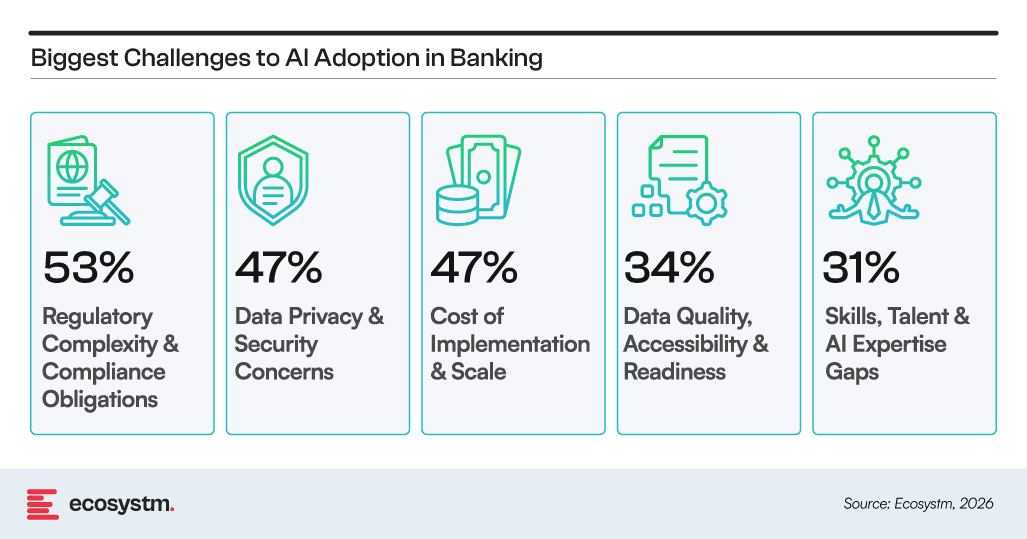
Data-related constraints are equally central. Concerns around privacy, security, quality, and accessibility point to structural issues in how data is captured, integrated, and made usable across legacy and modern systems. These limitations continue to shape how quickly AI can be embedded into core banking processes.
Cost remains a practical constraint. Implementation and scaling require sustained investment, particularly in environments with legacy infrastructure and multiple system dependencies. Skills and talent gaps continue to slow adoption in more specialised areas, where banks rely on a smaller pool of AI and data expertise.
Adoption patterns reflect where execution is most feasible. Use cases with clearer regulatory interpretation, stronger data availability, and lower integration complexity tend to move ahead first, while more complex deployments require longer cycles of alignment across governance, technology, and operating models.
3. AI Moves into Operations, With Regulation Adapting
The defining shift in banking AI is agentic systems capable of triggering actions across financial workflows with significantly greater autonomy and with significantly less human intervention at each step.
This is already visible in payments and fraud detection. Commonwealth Bank of Australia has launched a USD 1B AI initiative deploying agents that monitor transaction data, detect emerging fraud and scam patterns, and automatically generate new protective rules. DBS and Visa are piloting agentic commerce across Asia Pacific, where AI systems can complete everyday transactions using secure, issuer-controlled payment flows. Mastercard has completed authenticated agentic payment pilots in Malaysia with CIMB and RHB. Ant International has introduced the Agentic Mobile Protocol to connect AI agents with digital wallets, banking apps, super apps, and mobile portals, reducing setup steps significantly while providing a money-back guarantee for agent-initiated transactions.
The significance extends beyond technology deployment. When AI systems begin to search, select, authenticate, pay, detect fraud, or recommend protective actions, financial institutions need stronger controls around consent, accountability, auditability, and customer protection. Regulators are responding. APRA has flagged that AI adoption is outpacing governance frameworks in Australian financial institutions, raising concerns around concentration risk and cyber exposure. Vietnam’s central bank has mandated that banks and e-wallet providers notify customers before AI systems interact directly with them. Across the region, AI is moving from support tool to active operational participant and regulatory frameworks are racing to catch up.
4. Cross-Border Payments Are Being Rewired from the Infrastructure Up
Asia Pacific’s payments landscape is being reshaped simultaneously by real-time payment rail integrations, QR interoperability agreements, card network expansion, and the arrival of regulated stablecoins.
Vietnam and South Korea have launched cross-border QR payments enabling tourists to pay through domestic banking apps without cash exchange. Vietnam and China have integrated their central bank digital payment systems to facilitate seamless trade and tourism payments in local currencies. India is exploring a UPI-Alipay+ link that would extend UPI’s reach to merchant locations across Singapore and broader Asia. The Philippines and UAE are connecting instant payment rails specifically to make remittances faster and cheaper for overseas Filipino workers. Mastercard has launched a dedicated cross-border payments suite for Asia Pacific SMEs, designed to give small businesses the same speed and transparency in international payments as domestic transactions.
Stablecoins are adding a further structural layer. HSBC has received a Hong Kong stablecoin issuer licence and plans to launch an HKD-denominated stablecoin in H2 2026, backed 1:1 by reserve deposits and designed to facilitate instant retail payments and tokenised asset trading. This points to a future where regulated tokenised payment instruments operate alongside real-time rails, card networks, and wallet ecosystems, as an additional layer of the same emerging architecture.
What is notable is the diversity of actors driving this change. Central banks, commercial banks, payment networks, fintechs, and digital wallet providers are all building different parts of the same infrastructure simultaneously. The goal is faster, cheaper, and more interoperable regional payments, with more participants and more rails than the system was originally designed to support.
5. Climate and Catastrophe Risk Are Becoming Balance Sheet Issues
Climate risk is moving from sustainability reporting into the core of financial institutions’ strategy, governance, and capital planning, and regulators are making that shift explicit.
MAS has issued transition planning guidelines setting expectations for banks, insurers, and asset managers to assess climate-related risks and integrate them into strategy, risk management, and capital frameworks, framed as a prudential requirement, not a disclosure exercise. Vietnam’s Techcombank has secured a USD 232M facility from the European Investment Bank to expand lending for renewable energy, energy efficiency, and sustainable transport. The Asian Development Bank has issued inaugural catastrophe bonds creating rapid-deployment financial mechanisms for disaster relief across climate-exposed markets.
The broader implication for banking is clear. Institutions that treat climate primarily as a reporting obligation will fall behind those building it into credit assessment, green lending portfolios, and capital allocation decisions. As physical and transition risks intensify across Asia Pacific’s most climate-exposed markets, the ability to price, structure, and manage climate-linked financial products is becoming a core banking capability.
Ecosystm Opinion

Competitive advantage in banking is increasingly shaped by the ability to combine intelligence with operational execution at scale. As AI systems begin to initiate payments, detect fraud, and support risk decisions, the focus shifts toward how effectively these capabilities are integrated into core banking workflows.
This places greater emphasis on interoperability, data readiness, and the ability to expose secure, governed services across payments, risk, and customer systems. Institutions that can operationalise AI within these constraints are better positioned to move from isolated use cases to embedded capability.
Architecture decisions around APIs, data platforms, and event-driven systems become central to how banking services are delivered and orchestrated across ecosystems. The competitive question is increasingly about how reliably these capabilities can be executed within regulated, high-trust environments.

- Where are banks using AI today
Most production use is in onboarding, fraud detection, employee productivity tools, customer analytics, and operational risk monitoring rather than standalone “new AI products”.
- Why is onboarding a big focus if banks are already digital?
Because identity verification, fraud checks, and compliance requirements still sit behind most onboarding journeys and remain expensive and manual to scale.
- What AI use cases are banks prioritising first?
Banks tend to start with internal productivity, fraud detection, and onboarding improvements because they are easier to integrate and show measurable operational impact.
- What is stopping banks from scaling AI beyond pilots?
It usually comes down to regulatory approval cycles, fragmented or poor-quality data, cost of integration with legacy systems, and shortage of experienced talent.
- Is regulation the main reason AI adoption is slow in banking?
It’s less about slowing adoption and more about shaping which use cases move first—especially those with clearer governance and auditability.
- How are banks dealing with data privacy issues when using AI?
By restricting AI to controlled datasets, strengthening internal governance, and prioritising use cases where data lineage and access controls are already mature.
- What does “agentic AI” actually mean in a banking context?
It refers to AI systems that can take actions within defined rules—like flagging fraud patterns, triggering alerts, or executing parts of a workflow such as payment validation.
- Are banks really letting AI take actions on transactions?
In limited and controlled environments, yes—mainly for fraud detection, transaction monitoring, and assisted decisioning rather than fully autonomous financial decisions.
- How are regulators reacting to AI being used in core banking processes?
They are focusing on governance expectations, customer transparency, auditability, and ensuring customers know when AI systems are interacting with their accounts or transactions.
- What is changing in cross-border payments now?
Banks and payment systems are connecting real-time rails, QR systems, and settlement networks, with early exploration of tokenised and stablecoin-based settlement models.
- Are stablecoins being used in banking yet?
They are still early-stage but moving through licensing, pilot programs, and regulatory frameworks rather than remaining purely conceptual.
- Why is climate risk discussed in banking strategy meetings?
Because it directly affects lending risk, capital allocation, regulatory compliance, and portfolio exposure—especially in climate-sensitive markets across the region.
- What does climate risk look like in day-to-day banking operations?
It shows up in credit assessments, lending decisions, stress testing, and emerging requirements for transition planning and disclosure.
- What will separate leading banks from others over the next few years?
It will be their ability to connect AI, data, and infrastructure in a way that works reliably inside regulated environments—not just deploying individual use cases.