Across Asia Pacific, enterprises are rapidly embedding AI into core business strategy, but many are still struggling to move from experimentation to sustained, scalable value. The main constraint is the underlying data environment, most of which was not designed for AI workloads. Fragmented systems, inconsistent governance, and uneven data maturity mean that data is often available in parts, but not coherent or reliable enough to support production-grade, cross-domain AI.
The report examines these structural data challenges in detail and how they limit enterprise AI scale, even when individual use cases succeed. It also explores how the shift toward agentic AI increases the stakes, as weaknesses in data quality, access, and governance begin to translate directly into operational risk when AI moves from generating insights to executing actions across systems. It concludes with practical steps for building AI-ready data foundations across architecture, governance, and execution.















1. Why do organisations fail to convert AI investments into measurable business value?
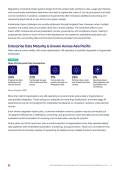
While 66% of organisations are experimenting with or deploying AI, only 10% achieve measurable value because they treat AI as a use-case funding exercise rather than a system-wide transformation. Value only emerges when strategy, operating model, and data layer are aligned. Most organisations fail at the data layer, where fragmented systems and inconsistent governance prevent AI from scaling beyond isolated pilots.
2. Why is there such a large gap between AI adoption and AI value creation?
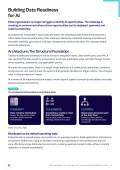
The gap exists because AI success depends on production-ready data environments, not experimentation environments. Most enterprises can support pilots with limited, well-bounded data sets, but struggle when AI must operate across distributed systems, inconsistent definitions, and real-time workflows. This breaks scalability and limits enterprise-wide impact.
3. What are the biggest operational barriers to enterprise AI adoption today?
The most common barriers are poor data quality or lack of usable context (53%), risk of sensitive data exposure during training (47%), difficulty securing data across distributed environments (45%), limited access across siloed systems (44%), and regulatory restrictions on data movement (34%). These constraints collectively prevent AI systems from operating reliably in production environments.
4. How do AI data requirements differ from traditional analytics systems?
Traditional analytics systems are designed for deterministic queries, structured data, and periodic reporting. AI systems are non-deterministic and require continuous, real-time access to structured, semi-structured, and unstructured data across multiple domains. They depend on contextual consistency rather than static data extracts.
5. Why do traditional integration layers fail for enterprise AI systems?
Integration layers solve connectivity but not semantic consistency. Even when systems are technically connected through APIs, differences in definitions, ownership, and governance mean the same data can carry different meanings across functions. This creates inconsistent AI outputs when models operate across domains.
6. Why does AI break when it moves from isolated use cases to enterprise scale?
AI pilots succeed because they operate within controlled environments with limited data sources. At scale, AI must operate across fragmented systems with inconsistent governance and conflicting definitions. This introduces variability in inputs, which leads to unreliable outputs and breaks repeatability in production environments.
7. Why does agentic AI increase enterprise risk?
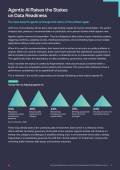
Agentic AI systems don’t just generate outputs—they execute actions across enterprise systems such as ERPs and CRMs. This means that data errors no longer affect insights alone; they directly trigger operational outcomes such as transactions, workflows, and decisions, turning data issues into business risks.
8. What are the main barriers to adopting agentic AI in enterprises?
The biggest barriers are regulatory compliance across autonomous decision-making (53%), ensuring data readiness and integrity (49%), and maintaining transparency and explainability (43%). These challenges reflect the difficulty of ensuring reliable data and governance when AI systems operate independently across distributed environments.
9. What is minimum viable governance in enterprise AI?
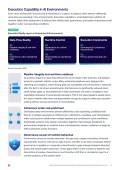
Minimum viable governance is a risk-tiered governance approach designed for distributed data environments. Instead of applying uniform controls across all data, it focuses enforcement on high-risk areas such as sensitive datasets, high-impact AI systems, cross-border flows, third-party integrations, and autonomous data pipelines.
10. How is embedded runtime governance different from traditional data governance?
Traditional governance is applied after data is stored, using audits, documentation, and periodic compliance checks. Embedded runtime governance enforces controls directly within data flows, including real-time access control, continuous lineage tracking, policy-driven processing rules, and live compliance signal generation.
11. Why is governance shifting into real-time data pipelines?
Because AI systems operate continuously and across distributed environments, static governance is too slow and disconnected. Real-time enforcement ensures that access, compliance, and usage rules are applied at the point of data movement, not after the fact, reducing risk in production AI systems.
12. How can organisations use sensitive data for AI without breaching privacy regulations?
Enterprises are increasingly avoiding raw data exposure by using synthetic data to simulate real datasets, federated learning to train models without centralising data, and differential privacy to prevent models from memorising sensitive information. These approaches allow AI training while preserving compliance and data protection.
13. What is synthetic data and when is it used in enterprise AI?
Synthetic data is artificially generated data that preserves statistical properties of real datasets without exposing actual individuals or entities. It is used when real data is too sensitive or regulated, such as in financial services fraud detection, healthcare imaging, or infrastructure modelling.
14. What is federated learning?
Federated learning is a method where AI models are trained locally within distributed environments where data resides. Instead of moving data into a central location, only model updates are shared, enabling collaboration across organisations without exposing raw data.
15. What is differential privacy and why is it important?
Differential privacy is a technique that introduces controlled statistical noise during model training to prevent AI systems from memorising individual data points. It ensures that outputs remain useful while protecting sensitive or regulated information from being reconstructed or leaked.
16. What should enterprise leaders prioritise to build an AI-ready operating model?
Leaders need to move beyond infrastructure upgrades and focus on shared accountability between IT and data teams, embed governance into system design rather than applying it post-deployment, design for coordination across distributed environments instead of centralisation, and manage AI as an end-to-end system where data, infrastructure, and applications operate as a single interconnected stack.