

Even the items lower on the list, such as performance monitoring or multi-agent governance, represent real challenges that organisations must address to scale AI safely and effectively.
Each concern maps directly to governance layers like financial limits, security controls, privacy protections, and auditability, turning high-level risks into enforceable actions that keep AI safe, accountable, and reliable.

The Governance Layer & Technical Controls
1. Financial Governance: Operational Circuit Breakers
Autonomous agents can execute financial and operational decisions faster than humans, but without proper guardrails, speed can quickly become risk. Effective governance moves enterprises from retroactive auditing to proactive control, combining operational oversight with financial discipline.
Mitigation Strategies:
- Adaptive Spend Sharding. Assign micro-budgets to specific agent clusters. For example, a procurement agent may have a USD 5,000 daily limit, with any single transaction above USD 500 triggering automated step-up authentication via the budget owner’s device.
- Recursive Loop Detection. Monitor agent actions for circular or repetitive patterns. If an agent repeatedly spins up and tears down the same cloud instance, the system automatically halts the workflow.
- FinOps Integration. Connect agent actions to cost monitoring dashboards and budget policies, providing real-time visibility of spend, resource usage, and efficiency metrics.
Business Impact: Financial and operational decisions remain automatically constrained to defined limits, preventing “hallucinated spending” and reducing waste.
2. Security Governance: Zero-Trust Agent Architecture
Autonomous agents operate with privileges, yet they cannot be fully trusted. Traditional security models assume a human is at the keyboard, but agentic AI introduces new attack surfaces that require continuous monitoring and containment.
Mitigation Strategies:
- Indirect Prompt Injection (IPI) Defence. Defend against manipulation when agents pull data from emails, documents, or the web. Implement dual-LLM verification so that a “Primary Agent” proposes actions while a hardened “Security Shadow” audits the proposals against a whitelist of approved commands.
- Hardened Sandboxing. Run agents performing code execution, script generation, or API calls in ephemeral, stateless containers with zero network egress. This prevents errors, malicious instructions, or hallucinated commands from affecting other systems while allowing agents to operate at full velocity within a controlled environment.
- Integration with SecOps. Feed real-time telemetry from agents into SIEM dashboards, anomaly detection engines, and operational monitoring tools. This enables security teams to continuously monitor agent behaviour, detect suspicious activity quickly, and respond to potential breaches or operational anomalies.
Business Impact: Security governance ensures that AI-driven decisions remain safe, auditable, and contained, even under high operational velocity.
3. Privacy Governance: Data Sovereignty and Just-in-Time Access
Autonomous agents require access to sensitive data to perform effectively. However, unnecessary data exposure increases regulatory risk, audit complexity, and reputational vulnerability. Privacy governance focuses on minimising data access, controlling persistence, and aligning AI workflows with existing enterprise data protection standards.
Mitigation Strategies:
- Just-in-Time (JIT) De-identification. Mask or tokenise sensitive fields, such as personal identifiers or financial data, before processing. Limit agents to the minimum dataset required for task completion and avoid exposing raw source records unless strictly necessary.
- Limiting Context Persistence. Restrict session memory to the duration of a task and clear contextual data after completion. Use ephemeral containers, short-lived access tokens, and controlled logging policies to reduce the risk of unintended data reuse or leakage across workflows.
- Regional Anchoring. Route agent workloads involving regulated data to approved regional infrastructure. Align deployment patterns with existing data sovereignty policies and cloud provider compliance configurations.
- Integration with Data Governance Tools. Connect AI workflows to established DLP systems, identity and access management controls, and compliance monitoring dashboards. Extend existing data classification and retention policies to agent-based systems rather than creating parallel governance tracks.
Business Impact: Sensitive data exposure is reduced without limiting analytical capability. Regulatory obligations are upheld, audit readiness improves, and AI adoption aligns with established enterprise data governance standards rather than introducing new, unmanaged risk domains.
4. Operational Governance: Policy-as-Code and Dynamic Oversight
Managing autonomous workflows requires a governance framework that is both enforceable and adaptive. Policy-as-Code embeds rules directly into the infrastructure, ensuring agents operate within defined boundaries while maintaining operational speed and reliability across distributed systems.
Mitigation Strategies:
- Policy Sidecar Enforcement. Route every agent request through a decoupled policy engine (e.g., Open Policy Agent) that evaluates actions against pre-defined rules before execution.
- Dynamic Permission Management. Grant temporary, context-aware privileges. For example, an agent handling a critical incident can receive elevated access that automatically revokes once the task completes.
- Orchestration-Integrated Controls. Integrate policy checks directly with RPA tools and workflow engines to maintain consistent governance across automated processes, reducing gaps between systems.
- Continuous Compliance Monitoring. Capture workflow logs, alerts, and dashboards in real time to detect deviations early and enable prompt corrective action.
Business Impact: Operational risk is reduced without slowing automation. The framework ensures AI workflows remain compliant, auditable, and adaptive, allowing enterprises to scale agent networks safely while maintaining process consistency and operational fluency.
5. Legal & Ethics Governance: The Immutable Decision Record
Agentic AI make decisions that directly affect customers, employees, and regulatory reporting. Capturing only outputs is insufficient; organisations need a complete record of reasoning and context to ensure accountability and transparency.
Mitigation Strategies:
- Chain-of-Thought (CoT) Logging. Record each decision step alongside outcomes, with structured timestamps that allow the process to be reconstructed and queried later.
- Digital Notarisation. Hash and store high-stakes decisions in immutable storage, creating a tamper-proof audit trail akin to aviation “black boxes.”
- Compliance Workflow Integration. Feed logs directly into regulatory reporting systems and internal compliance dashboards, enabling real-time audits and proactive issue resolution.
Business Impact: Organisations gain verifiable, evidence-based records of AI-driven decisions. This reduces regulatory and reputational risk while ensuring decisions are defensible, auditable, and aligned with ethical standards.
6. Emergency Governance: Master Kill-Switch & Resilience Controls
Even with layered safeguards, autonomous agents can behave unexpectedly. Organisations need the ability to intervene immediately, contain errors, and prevent cascading impacts across workflows.
Mitigation Strategies:
- Quarantine Mode. Temporarily restrict an agent’s write permissions while allowing it to continue reporting and diagnosing its own reasoning, so issues can be investigated without disrupting operations.
- Global Token Revocation. Instantly invalidate all active agent sessions or sub-meshes if a critical exploit, logic error, or provider compromise is detected, preventing further unintended actions.
- Integration with Security & Operations Dashboards. Centralised monitoring allows incident response teams and executives to observe, evaluate, and intervene in real time, ensuring decisions remain under organisational control.
Business Impact: Enterprises can maintain operational continuity even during agent failures or security incidents. The system ensures that autonomous workflows remain observable, contained, and reversible, giving leaders confidence in the resilience and reliability of AI at scale.
Governance as the Backbone of Scalable Agentic AI
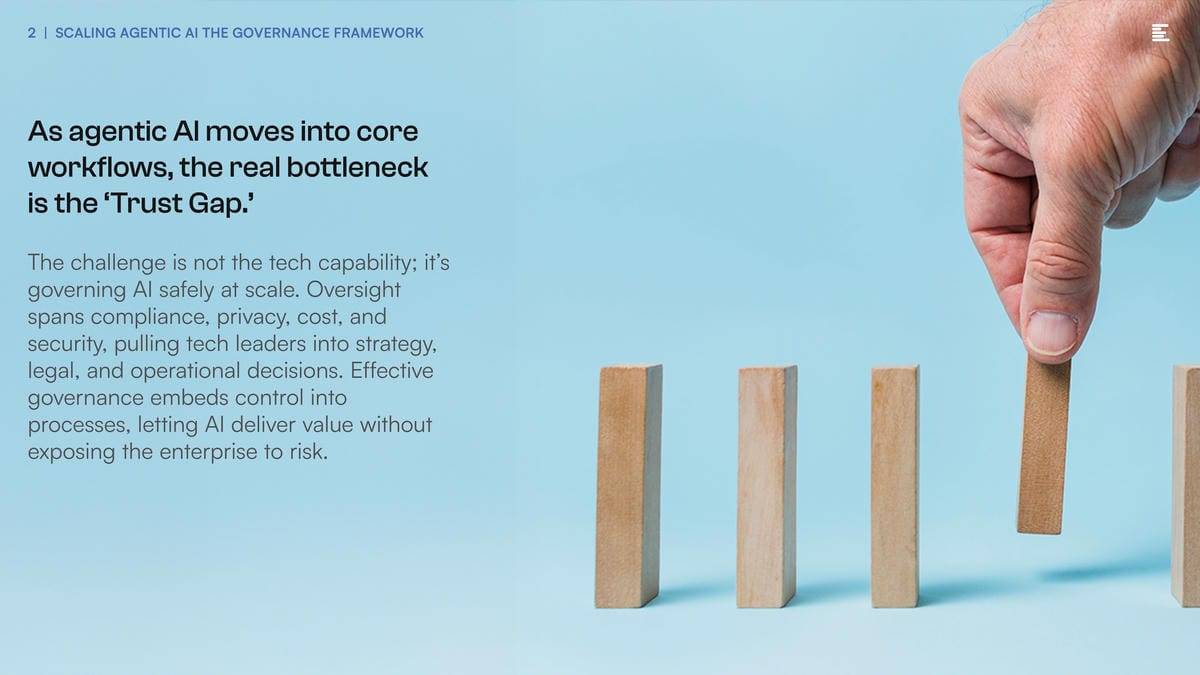
Scaling agentic AI requires embedding trust across compliance, privacy, finance, security, and operations. Effective governance turns high-level risks into enforceable controls, ensuring autonomous agents operate efficiently, safely, and within policy. By connecting technology with organisational processes, enterprises can scale AI confidently, keeping workflows auditable, secure, and aligned with business objectives.