New Zealand sits at a crossroads. Economic pressure is rising while productivity remains stubbornly flat, and AI is increasingly being presented as the solution to both challenges. More recently, the debate has narrowed to AI as a way of reducing headcount – a narrative that fits New Zealand’s long-standing “do more with less” mindset but risks confusing efficiency with productivity.
Organisations are moving quickly on AI deployment, while the redesign of work, processes, and decision-making remains a slower and less certain task. New Zealand’s economic and institutional settings encourage rapid deployment, yet many of the gains from AI depend on changes to processes, roles, decision-making, and operating models. This creates a productivity paradox: organisations can move quickly on AI adoption while making only limited progress on productivity.
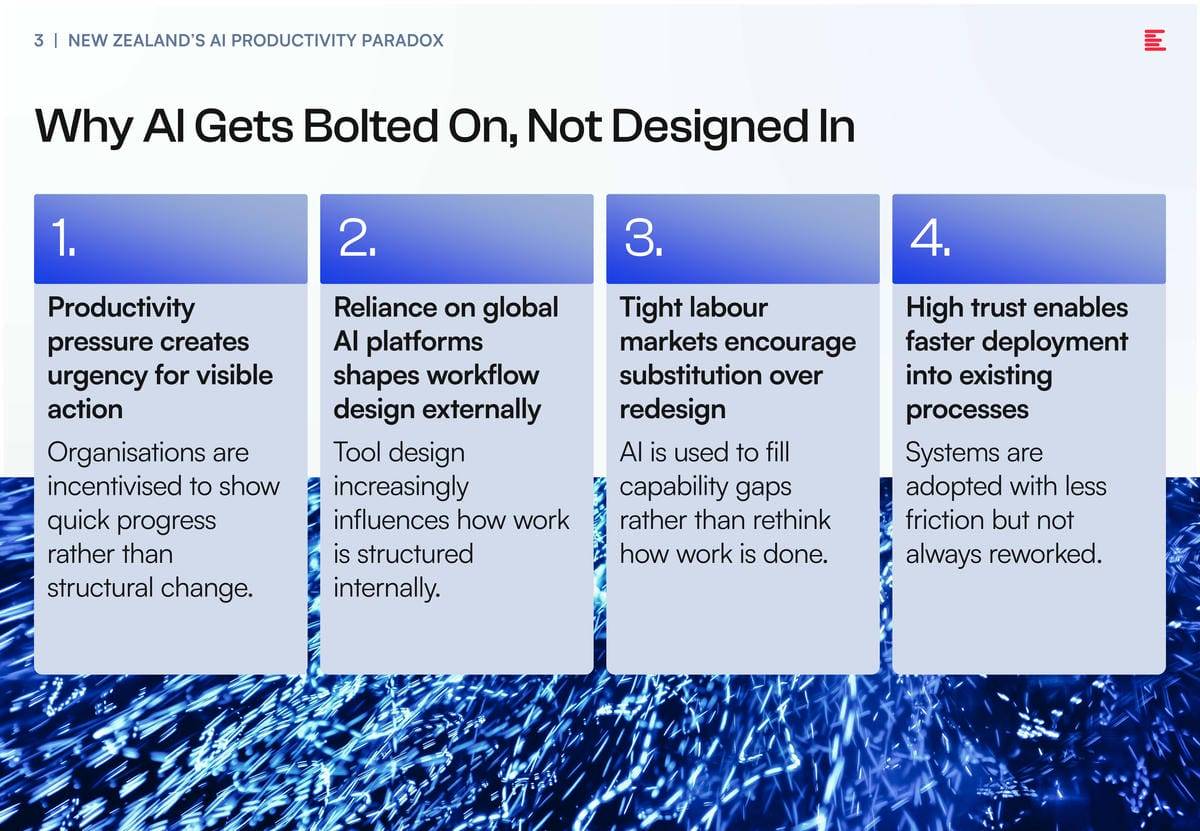


Why AI Gets Bolted On, Not Designed In
Studies such as the New Zealand AI Forum’s 2025 AI in Action report show that New Zealand’s challenge is not a lack of understanding that AI can play a key role in lifting productivity. Instead, it lies in the structural forces that encourage organisations to bolt AI onto existing workflows rather than take a productivity-by-design approach. These forces make rapid deployment appear to be the easier path, while making deeper redesign harder to prioritise. Understanding them is important because they help explain why New Zealand risks accelerating activity without materially improving productivity, and why redesign – not speed – needs to become the organising principle for AI-enabled transformation.
- Productivity pressure creates “solution urgency”. New Zealand’s long‑standing productivity narrative creates a bias toward fast and visible perception of action. This creates a psychological environment where AI can be framed as a fast fix rather than a redesign challenge, reinforcing the belief that productivity can be achieved through tools rather than through operating model change.
- New Zealand’s high dependency on global platforms. Unlike larger economies, New Zealand has a limited ability to build sovereign AI infrastructure. Therefore, the reliance on global AI vendors creates a subtle but significant risk: inheriting offshore assumptions about how work should be structured, where the tools used define the workflow, not the organisation.
- Tight labour market creates substitution temptation. New Zealand’s productivity challenge is not a surplus of workers; rather, it is a shortage of critical expertise with local knowledge. The most valuable use of AI is not replacing people but extending the reach and capability of people who cannot easily be replaced.
- Trust can reduce pressure for redesign. In environments with relatively high levels of trust and organisational alignment, AI can be deployed quickly into existing processes. The risk is that organisations focus on introducing new tools rather than questioning how work should be redesigned, limiting the productivity benefits that AI can deliver.
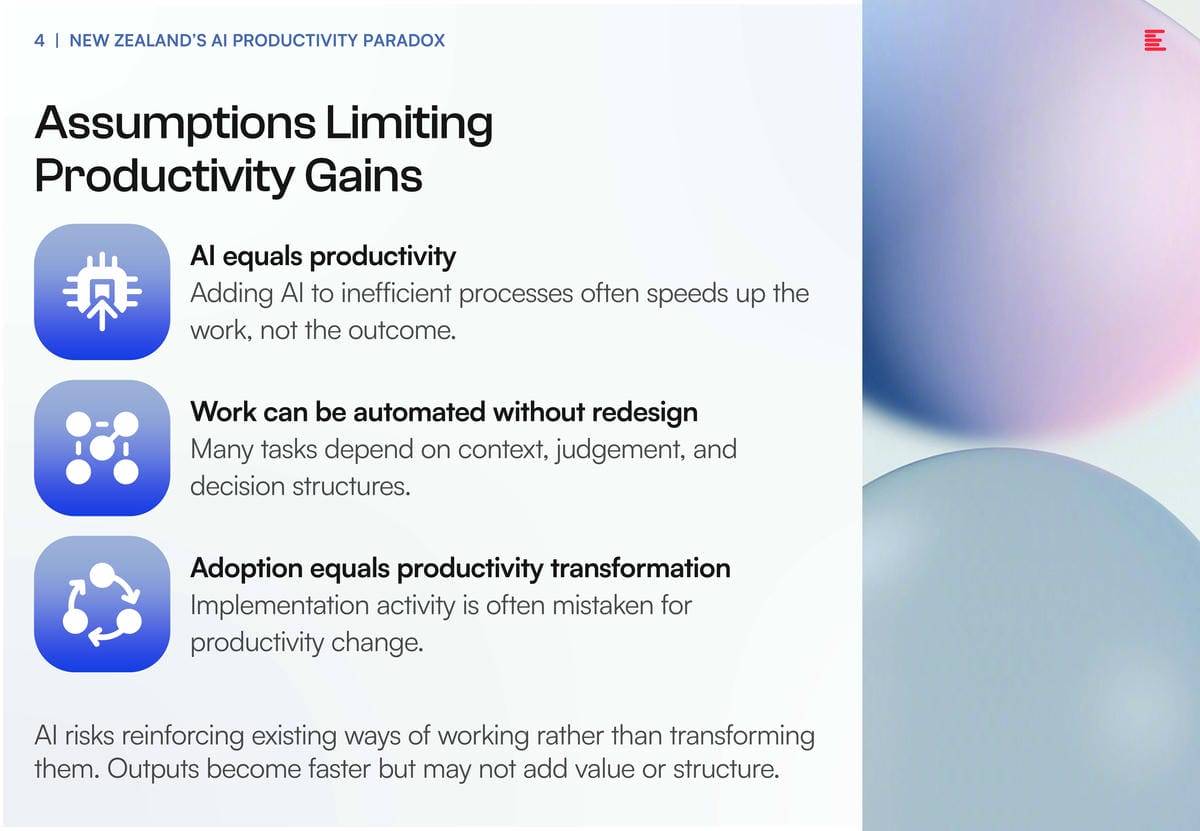
The Assumptions Limiting Productivity Gains from AI
Despite the momentum and hype around the role of AI, much of New Zealand’s productivity conversation is still anchored in a set of flawed assumptions about what AI can realistically deliver. These assumptions create misplaced confidence, distort investment decisions, and encourage organisations to automate existing workflows without considering the redesign that will need to take place. These assumptions explain why AI often accelerates activity without improving (and in many cases reducing) productivity and why a shift toward productivity‑by‑design is essential.
Assumption 1: AI equals productivity. Adding AI to a poorly designed process often results in a faster version of the same inefficient process. Complex processes, multiple approval layers, fragmented data, and legacy systems are factors that compound productivity inertia. For example, a policy draft was produced in minutes. But if that paper still requires six reviews, three committees, and multiple rounds of consultation, the overall process may barely change.
Assumption 2: Work can be easily automated. Some tasks are automatable, but many are not. For example, government workflows also include policy judgment, equity and Te Tiriti considerations, political accountability and community context. These cannot be delegated to AI without redesigning roles, decision rights, and guardrails.
Assumption 3: Adoption equals productivity transformation. New Zealand is an adoption‑first environment, then redesign processes. In other countries like Singapore, there is a redesign‑first environment. The difference is structural – adoption produces activity while redesign promotes productivity.
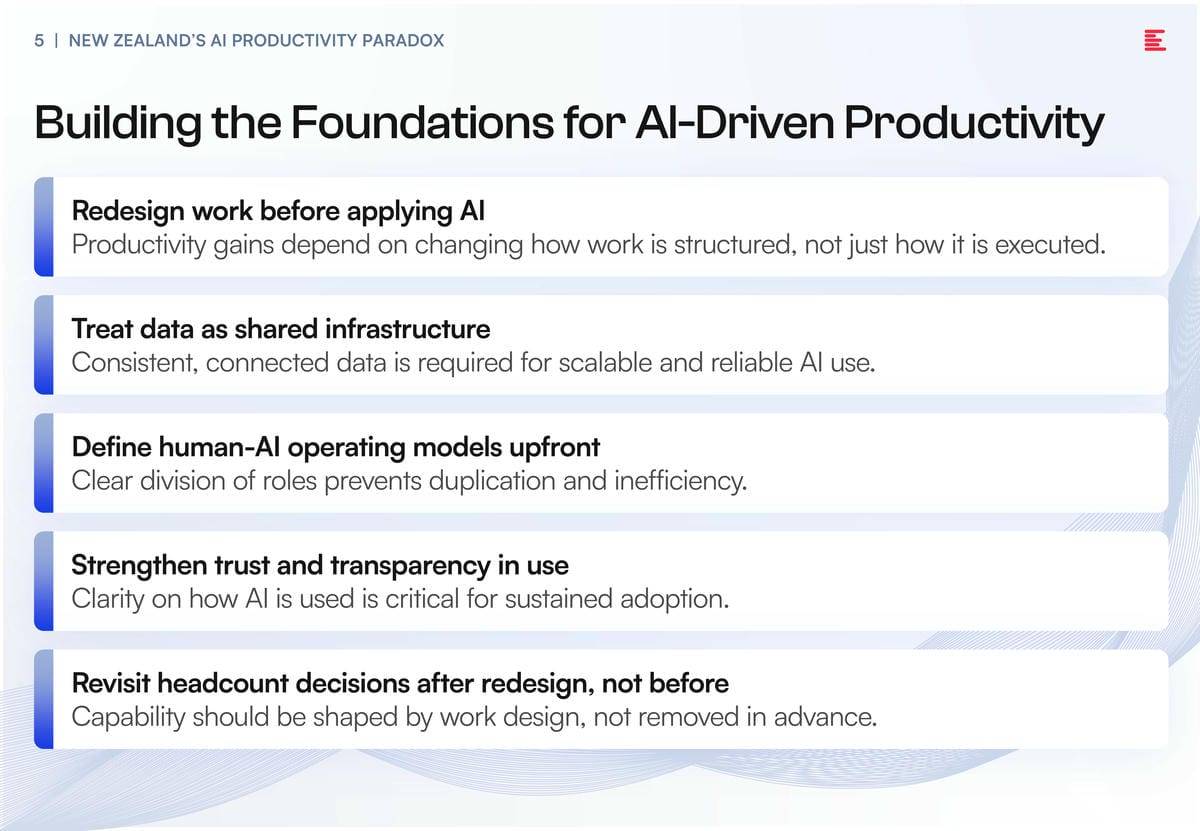
Building the Foundations for AI-Driven Productivity
Building real productivity from AI requires more than deploying new tools. It requires a deliberate redesign of the foundations that determine how work is structured, governed, and executed. This is why headcount reduction is not a defensible starting point; it can introduce structural risk. Once roles are removed, organisations lose critical knowledge, context, and experience that are difficult to rebuild, especially in a small labour market.
The countries achieving meaningful productivity gains are not those adopting AI the fastest, but those using it to create value and extend workforce capability rather than focusing on short-term efficiency gains. For New Zealand, this implies shifting from adoption-first thinking to a system-level redesign agenda well before any consideration of reducing headcount. Using this approach, there are five foundations that need to be in place before AI can deliver sustained productivity gains in New Zealand organisations.
- Redesign work as the starting point for productivity-by-design. Productivity-by-design begins with the work itself. AI cannot deliver meaningful gains if it is layered onto processes that were not designed with it in mind. When organisations deploy AI without redesign, they tend to accelerate existing inefficiencies rather than remove them. The principle is straightforward: fix the system first, then apply AI where it fits.
- Treat data as shared productivity infrastructure. Establish unified data governance so AI can operate on consistent, context-rich information across New Zealand. Fragmented data produces fragmented outcomes; shared infrastructure enables reuse, consistency, and cross-agency scalability.
- Build a hybrid human–AI operating model before deployment, not after. Organisations that deploy AI without redesigning roles and decision rights often scale inefficiency rather than productivity. The operating model needs to be defined upfront: what AI does, what humans retain, how escalation works, and what skills are required. This ensures AI extends capability rather than displacing it in ways that erode institutional knowledge.
- Strengthen trust and transparency as preconditions for AI-driven productivity. Trust is central to whether AI can operate effectively in services. Citizens and frontline employees need clarity on when AI is used, how decisions are made, and who is accountable. Without this, AI-enabled workflows become points of friction that slow adoption and reduce confidence. Trust therefore depends on clear decision pathways, defined escalation rules, and visible accountability, not communication alone.
- Reassess headcount decisions until work is redesigned. Reducing roles before redesigning work removes the knowledge needed to create effective systems. A deliberate pause allows organisations to map work, identify inefficiencies, and redesign decision flows before introducing AI. This reframes the question from “who can be removed” to “what work should exist and how should it be structured with AI”.
Real productivity in New Zealand will come from redesigning work, data, roles, and governance rather than from cutting headcount or layering AI onto existing systems. The countries moving ahead are demonstrating that productivity is shaped by design choices, not efficiency drives, and that AI only delivers value when the operating environment is ready for it.