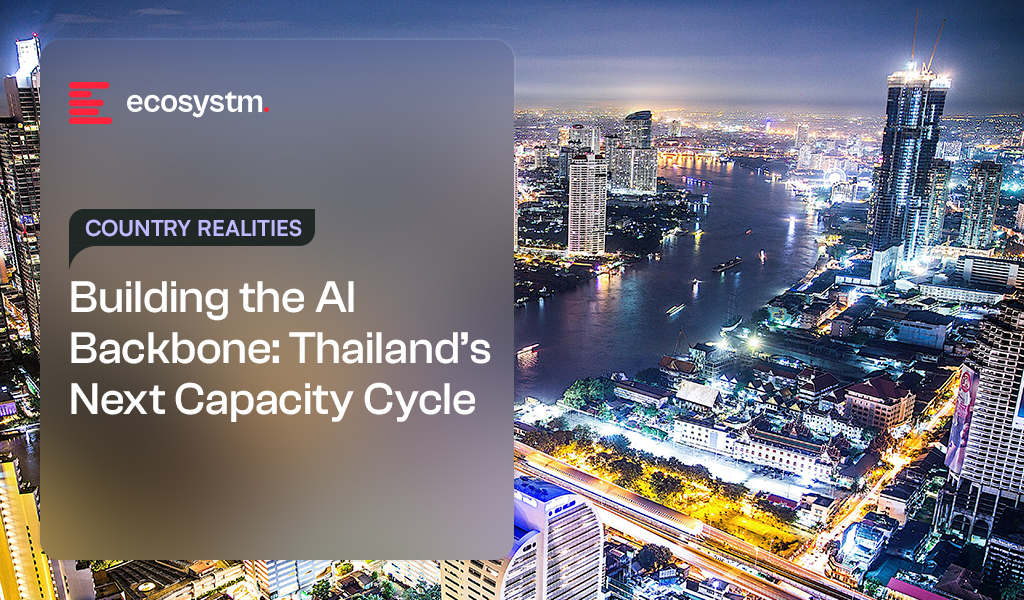
Thailand’s AI push is influencing parts of the economy that sit well beyond the technology sector. Earlier phases of digital growth were largely centred on expanding connectivity, consumer applications, and enterprise digitisation. The current phase is putting pressure on more foundational areas – infrastructure capacity, energy availability, workforce readiness, industrial competitiveness, and domestic control over critical technology layers.
This is changing the shape of investment and policy priorities. More attention is now going into data centres, cloud and compute infrastructure, advanced connectivity, semiconductor capability, and domestic AI ecosystems spanning local models, research partnerships, skills development, and governance frameworks aimed at reducing dependence on external platforms.
AI is also becoming more closely tied to Thailand’s longer-term economic constraints. Labour force growth is slowing, the population is ageing, and industries are under pressure to improve productivity and move up the value chain. As a result, recent developments across infrastructure, workforce programmes, sovereign AI initiatives, and sector modernisation are not standalone technology efforts but interconnected responses to broader economic and industrial pressures.


Rewiring the Infrastructure Base for AI
What’s changing in Thailand right now is not just interest in AI infrastructure, but the speed and scale at which physical capacity is being added to support it. Data centres, power provisioning, connectivity upgrades, and regulatory throughput are increasingly being treated as a single system rather than separate constraints. As cloud platforms scale and AI workloads become more compute-intensive, focus is shifting to building and operationalising infrastructure fast enough.
Recent investment activity reflects this shift in a very tangible way. Thailand’s Board of Investment has cleared about USD 29B in major projects, with a large share directed towards digital infrastructure, including major data centre developments across Bangkok, Samut Prakan, and Chachoengsao. A further USD 3.1B in dedicated data centre investments has also been approved, adding to the country’s planned compute capacity as regional demand for AI and cloud infrastructure rises.
What stands out are the adjacent capabilities beginning to form around this expansion. Semiconductor and photonics partnerships involving government agencies, universities, and industry players are aimed at strengthening research capability, talent pipelines, and higher-value technology development. At the same time, hyperscalers such as Microsoft continue to deepen their infrastructure presence in Thailand, reinforcing the country’s position within regional cloud and AI supply chains.
The focus is also shifting towards reducing execution bottlenecks. AIS’s 5G-Advanced rollout is intended to support lower-latency enterprise and industrial workloads, while the government’s Thailand FastPass initiative is designed to shorten approval timelines for strategic investments. Taken together, it becomes clear that Thailand is moving from attracting AI infrastructure investments to how quickly projects can be built, connected, powered, and scaled.
The Emerging Sovereign AI Layer
A quieter but increasingly important shift in Thailand’s AI landscape is the move towards control over where models run, how data is handled, and who governs inference. As AI adoption deepens across critical sectors such as government, financial services, and healthcare, the emphasis is shifting from access to capability towards containment: keeping sensitive workloads within domestic infrastructure and regulatory boundaries.
This is where ThaiLLM is positioned. Developed under the National Science and Technology Development Agency (NSTDA) and built on Thailand’s ThaiSC supercomputing infrastructure, it provides a domestic environment for training and inference, optimised for Thai language performance and sector-specific use cases. Early deployments are being explored in regulated domains such as finance, healthcare, and public services, where language fidelity and data governance are operational constraints rather than design preferences.
Rather than a standalone model initiative, it is increasingly embedded into a wider institutional pipeline. NSTDA, the Digital Council, and the Asian Institute of Technology (AIT) are linking research, applied pilots, and sector deployments, including use cases in areas such as water management. This is not model development in isolation; this is a structured path from research infrastructure to governed, deployable systems.
Enterprise adoption is moving in a similar direction. True Corporation’s ‘AI-first tetco tech’ is integrating AI into core telecom operations, including network optimisation, customer processes, and internal governance. This positions AI as part of operational infrastructure rather than a separate digital layer.
These developments point to a gradual consolidation of Thailand’s AI stack across compute, models, institutions, and enterprise systems.
Rebuilding Workforce Capability Around AI Adoption
Thailand’s AI agenda is constrained by labour structure – an ageing population, slower growth in the working-age cohort, and rising demand for higher-value digital and industrial skills are tightening talent availability. As a result, AI adoption is becoming a stress test of whether organisations can redesign work fast enough to match changing operating models.
Capability-building efforts are addressing this gap. Instead of fragmented training programmes, there is a clearer move towards coordinated public–private initiatives to scale AI fluency. Microsoft’s THAI Academy, in partnership with the Department of Skill Development, targets 100,000 workers and job seekers with applied AI training. Google, True Corporation, and university partners are embedding AI curricula to address an estimated gap of around 80,000 AI-capable professionals across sectors.
The more important change is scope. Workforce interventions are moving beyond technical roles into functions where AI is embedded in daily execution – customer operations, finance, HR, and operational decision-making. The intent is to establish baseline AI capability across business functions.
Capability development is also being tied more directly to applied use cases. NSTDA, the Digital Council, and the Asian Institute of Technology (AIT) are linking workforce programmes with pilot deployments and sectoral experiments, including AI applications in water management and SME productivity. This creates a tighter loop between capability building, real-world deployment, and curriculum design.
AI readiness is not just a training exercise for Thailand. Skills, operating models, and AI deployment are evolving in parallel under sustained demographic and productivity pressure.
Where AI is Landing in Thailand
As infrastructure expands and institutional readiness improves, AI is beginning to surface in sectors that sit inside the country’s core economic and social systems such as industrial production, agriculture, public services, and tourism.
A key policy lever is the proposed USD 2.8B Transformation Fund, aimed at industrial modernisation and SME competitiveness. While framed broadly, its practical direction is clearer: accelerating digital and AI-enabled upgrades in legacy sectors where productivity gains have been limited and uneven.
In public services, AI is being embedded into welfare and social systems. Current deployments include AI-assisted sign language interpretation, structured elderly care systems, and a digital “family report card” designed to improve coordination across welfare services. These are embedding automation and decision support into administrative processes.
Agriculture shows a similar pattern of operational integration. An AI-enabled fertiliser recommendation programme is already being deployed across roughly 3,000 farmers, using localised inputs to optimise cost and yield decisions at the farm level. Again, this embeds AI into operational decisions rather than the advisory layer.
Tourism, a structurally important sector for Thailand, is also beginning to integrate AI into customer-facing systems. The Tourism Authority of Thailand has partnered with Mastercard to enhance the “Amazing Thailand” platform with AI-driven features aimed at improving personalisation, visitor engagement, and trip planning experiences. While early-stage, it signals how AI is being introduced into high-volume, service-intensive industries where experience differentiation is critical.
Across these examples, a consistent pattern is emerging. AI is moving from controlled environments into operational systems that carry economic and institutional weight. The test is whether it can function reliably inside fragmented data environments, legacy processes, and variable real-world conditions.
Ecosystm Opinion
Thailand’s AI trajectory is being defined by interdependence across layers that were previously treated separately. The pressure point is alignment rather than activity. Infrastructure capacity has value only when it translates into usable compute at scale. Domestic model efforts depend on institutional readiness to integrate them into workflows. Workforce initiatives are only meaningful if they reflect how systems of work are actually changing. And sector deployments only hold if the underlying data, governance, and infrastructure can sustain them beyond contained environments.
Success will be shaped by how effectively these layers are connected in practice; not through coordination in principle, but through operational integration across compute, systems, policy, and deployment environments.

- Why are AI pilots not scaling in Thailand?
Because most pilots are still not connected to the systems they are meant to operate in. Infrastructure, data environments, and enterprise workflows are evolving, but not in sync. As a result, pilots tend to work in controlled environments but break when exposed to fragmented legacy systems, regulatory constraints, and real operational variability.
- Is Thailand ready forGenAIat scale?
Thailand is not uniformly ready yet. Infrastructure investment is accelerating, including large-scale data centre approvals (USD 29B) and additional dedicated capacity (USD 3.1B), but enterprise readiness is uneven. Many organisations still operate with fragmented data, legacy applications, and limited integration across business functions, which slows down production-scale deployment.
- What isThaiLLM?
ThaiLLM is being positioned for regulated and language-sensitive use cases where domestic control matters. Built on NSTDA and ThaiSC infrastructure, it supports Thai-language processing and keeps data and inference within Thailand’s jurisdiction. Early applications are emerging in finance, healthcare, and public services where compliance and language fidelity are operational requirements, not optional features.
- 4. Do Thai enterprises needSovereignAI or is cloud enough?
Cloud remains the foundation, but sovereign AI is becoming relevant in sectors where data control, regulatory compliance, and inference location are critical. Government, BFSI, and healthcare organisations are increasingly evaluating AI not just on performance, but on where workloads run and how governance is enforced within national boundaries.
- What is driving data centre investment in Thailand?
The primary driver is the shift toward compute-heavy AI and cloud workloads. Thailand’s Board of Investment has approved around USD 29B in major projects, with a significant share in digital infrastructure, alongside an additional USD 3.1B in data centre expansion. This reflects a broader move to position Thailand as a regional node for AI and cloud infrastructure.
- What is ThailandFastPass?
FastPass is designed to reduce approval and regulatory delays for strategic investments such as data centres and infrastructure-heavy AI projects. Its relevance is in execution speed — as infrastructure demand rises, regulatory throughput becomes a binding constraint on how quickly AI capacity can actually be deployed.
- Where isAI being used in Thailand today?
AI is beginning to move into operational environments rather than just pilots. In agriculture, fertiliser optimisation is being deployed across 3,000 farmers. In public services, AI is being used in elderly care systems, sign language interpretation, and welfare coordination tools. In tourism, platforms like the “Amazing Thailand” app are integrating AI-driven personalisation through partnerships such as the Tourism Authority of Thailand and Mastercard.
- Whatis AIS 5G?
AIS’s 5G-Advanced rollout strengthens the connectivity layer required for AI workloads that depend on low latency and real-time responsiveness. It is particularly relevant for industrial and enterprise use cases where AI needs to operate closer to operational systems rather than in centralised cloud environments.
- Why arehyperscalers investing in Thailand?
Hyperscalers are expanding in Thailand due to rising demand for cloud and AI infrastructure and the country’s push to become a regional compute hub. Investments in cloud and AI infrastructure signal long-term confidence in Thailand’s ability to support large-scale, compute-intensive workloads.
- What is theAI skills gap in Thailand?
Estimates suggest a gap of around 80,000 AI-capable professionals across sectors. This is not limited to data scientists but includes a broader shortage of AI-fluent workers across business functions. As a result, workforce programmes are expanding beyond technical training into enterprise-wide AI fluency initiatives.
- What is MicrosoftTHAI Academy?
Microsoft’s THAI Academy, in partnership with Thailand’s Department of Skill Development, aims to train around 100,000 workers and job seekers in applied AI skills. The focus is on practical AI usage across roles, rather than deep technical specialisation alone, reflecting the broader shift toward AI fluency across the workforce.
- Why isthe workforce such a big constraint for AI in Thailand?
Thailand’s labour structure is changing due to ageing demographics and slower growth in the working-age population. This means AI adoption is not just about productivity improvement, but about whether organisations can redesign work fast enough to match new operating models and sustain economic competitiveness.
- What is blockingGenAI adoption in Thailand?
The main constraints are integration-related rather than model-related. Enterprises struggle with fragmented data systems, legacy infrastructure, and unclear operational ownership of AI. Even when models are available, embedding them into end-to-end workflows remains the hardest step.
- Whatare semiconductorsand photonics?
Because Thailand is trying to deepen its position in the AI value chain, not just consume infrastructure. Semiconductor and photonics collaborations between government, academia, and industry are aimed at strengthening talent pipelines, research capability, and long-term industrial competitiveness.