Enterprise applications are undergoing a shift that is often described as “AI adoption” but is in fact a structural change in what enterprise software is expected to deliver.
Traditional application models were designed to manage workflows, record transactions, and support human decision-making. As AI moves from assistive functions into core operational processes, applications are now expected to operate in more dynamic, interconnected environments, with higher expectations around control, transparency, and accountability.
This is reshaping the meaning of modernisation. It is not just about upgrading systems in isolation, but about ensuring applications can operate reliably across distributed environments, enable real-time access to data, and meet increasingly stringent requirements around compliance and continuity.
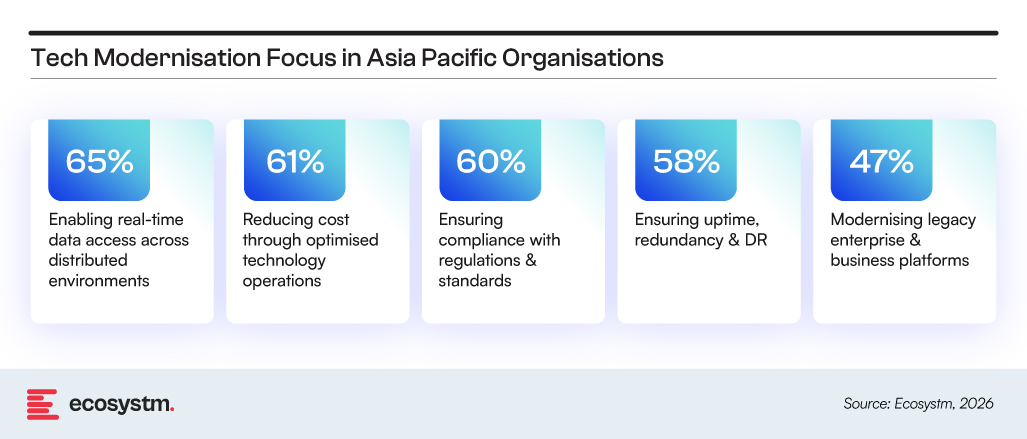
What is emerging is a different class of enterprise applications: systems that embed governance into workflows, use AI to influence and execute processes, and orchestrate across data, tools, and agents to deliver outcomes end to end. Recent Ecosystm conversations with enterprise leaders across the region point to a consistent direction: application strategy is shifting toward environments that are easier to run, govern, and adapt at scale.
These five trends outline how enterprise applications are evolving for more adaptive, AI-enabled operations.














1. Enterprise applications are decision-and-control systems, not workflow tools
Across enterprise environments, applications are being repositioned from tools that support work to systems that actively shape how decisions are made and executed. What was once primarily about routing tasks or standardising processes is now extending into the decision layer itself, where applications are expected to guide outcomes in a controlled and explainable way.
This shift is driving a fundamental redesign of how applications behave. Governance, auditability, explainability, and bias checks cannot be considered external controls applied after execution; they are being embedded directly into workflows. At the same time, AI outputs are expected to be traceable and defensible, particularly where decisions have operational, financial, or regulatory consequences. As a result, “trust” is becoming a design constraint that determines whether applications can scale in complex environments.

2. Applications are moving toward agent-driven execution inside business workflows
How work is actually executed inside enterprise applications is also changing. Rather than simply automating steps within predefined workflows, applications are beginning to incorporate AI agents that actively participate in execution.
These agents are being embedded across processes characterised by structured workflows, repeatable decisions, and high operational throughput. Their role is not confined to assisting users or suggesting actions; they can trigger actions themselves, based on context, risk signals, and system conditions. This introduces a more adaptive form of execution, where workflows are not linear but responsive to real-time inputs.
As this evolves, the role of employees will change. Instead of executing every step, they will manage exceptions, validate outcomes, and oversee edge cases. Execution becomes distributed between systems and agents, with humans focusing on oversight rather than direct operational handling.

3. Enterprise applications are converging into orchestration layers across systems
The most significant shift is not happening within individual applications, but across them. As enterprise environments become fragmented across ERP, CRM, data platforms, and specialised tools, integration on its own is no longer sufficient to deliver meaningful outcomes.
What is emerging instead is the need for orchestration – a coordination layer that manages how systems, data, AI agents, and workflows interact. This layer determines whether work flows smoothly across the enterprise or breaks down at system boundaries.
Orchestration defines throughput, consistency, and continuity of decision-making. Without it, even well-designed applications tend to operate in silos, limiting the value of AI and automation investments. With it, enterprises are able to align execution across multiple systems, ensuring that decisions and actions carry forward without fragmentation or rework.
This is shifting the centre of gravity away from individual applications toward the coordination layer that connects them.

4. Data is becoming inseparable from application runtime behaviour
Across modernisation programmes and AI-enabled transformation efforts, data does not function as a passive backend layer. Instead, it is directly shaping how applications behave in real time.
Applications that rely on AI or automation are dependent on clean, contextual, and low-latency data flows. Where data is fragmented or inconsistent, application intelligence and automation capabilities degrade quickly, limiting scalability and reliability. In contrast, well-connected data environments enable more adaptive and responsive system behaviour.
This is particularly visible in real-time decisioning, where applications are expected to act on continuously updated information rather than static inputs. As a result, the value of an application is being tied to how effectively it can maintain continuity of data across systems and use that data to drive execution.
Data is not separate from application logic; it is becoming a direct input into how applications behave at runtime.

5. Enterprise applications are being judged on execution outcomes, not feature depth
How applications are evaluated and selected is changing. Feature richness and functional breadth are becoming less important than measurable impact in real operating conditions.
Early AI adoption is concentrated in high-pressure operational areas where outcomes are immediately visible, such as fraud detection, customer onboarding, ERP transformation, and service operations. Value is defined less by capability lists and more by execution quality: speed, consistency, throughput, and reduction in operational friction.
This is also changing how technology providers and platforms are assessed. There is growing emphasis on demonstrated performance in live environments rather than theoretical capability or positioning. Proof in production is becoming a stronger signal than product narratives.

Ecosystm Opinion
Technology leaders today need to rework the assumptions these systems are built on and weave in execution discipline.
The next step is to move beyond incremental modernisation programmes and focus on redesigning how work actually flows through the enterprise. This means prioritising clarity of decision ownership inside systems, reducing ambiguity in how work is handed across tools and teams, and ensuring that automation does not simply replicate existing fragmentation at a higher speed.
It also requires a more deliberate approach to sequencing change. Many organisations are still attempting to modernise platforms, introduce AI, and stabilise operations in parallel. The more effective path emerging is selective consolidation of change, where complexity is reduced before intelligence is added, rather than the other way around.
This means that technology leaders will need to shift success measures away from system completeness or adoption metrics and toward operational consistency under real-world conditions. The differentiator will not be the sophistication of individual components, but the ability of the enterprise to maintain predictable outcomes as systems, teams, and decision flows evolve.
FAQ: AI in Enterprise Applications
Why are AI pilots failing to scale?
AI pilots often fail to scale because they are layered onto fragmented systems that were not designed for AI-driven execution. Without consistent data flows, clear governance embedded into workflows, and orchestration across systems, AI remains confined to isolated use cases rather than becoming part of end-to-end enterprise execution. Scaling requires redesigning how applications operate, not just adding intelligence on top.
Which business processes should be automated first?
The strongest candidates are structured, repeatable, high-throughput processes where decisions are well-defined and outcomes are measurable. These are typically areas where workflows can be clearly instrumented, data is reliable, and AI can influence execution without ambiguity. Processes that require heavy cross-system coordination or unclear ownership are less ready for automation.
Where do enterprise workflows usually break down?
Workflows most often break down at system boundaries where ERP, CRM, data platforms, and specialised tools are not coordinated. Lack of orchestration leads to fragmented execution, rework, and inconsistent decision flows. Breakdowns also occur when data is inconsistent or not available in real time across systems.
Why does work slow down across enterprise systems?
Work slows down because execution is still dependent on disconnected applications and manual coordination across teams and systems. Without orchestration and real-time data continuity, decisions get delayed at handoffs, validations, and system transitions. Fragmented governance and tooling further compound these delays.
How much autonomy should AI agents have?
AI agents can take on execution tasks in structured, repeatable processes, including triggering actions based on context and system conditions. However, autonomy must be balanced with human oversight, especially for exceptions, validation, and high-impact decisions. The key constraint is defining where control ends and delegated execution begins.
How can AI decisions be made explainable?
Explainability is achieved by embedding governance, auditability, and traceability directly into workflows rather than applying them after execution. AI outputs must be defensible, particularly where decisions have operational, financial, or regulatory impact. Trust becomes a design requirement, not an afterthought.
Why is fragmented data a problem for AI?
Fragmented data reduces the reliability of AI because applications depend on clean, contextual, and low-latency data flows to function effectively. When customer, product, or compliance data sits across disconnected systems, AI-driven execution slows down and becomes less accurate. Data directly shapes runtime behaviour, not just reporting.
Are legacy applications slowing down AI adoption?
Yes. Many legacy systems were designed for transactional processing and human-led decision-making, not AI-driven execution. They often lack the ability to support real-time data access, distributed environments, or embedded governance. This limits how effectively AI can be operationalised at scale.
Should complexity be reduced before adding AI?
Yes, selectively. The emerging approach is to reduce complexity before introducing intelligence, rather than layering AI on top of fragmented environments. Without simplification, AI risks amplifying existing inefficiencies and operational fragmentation instead of improving them.
What does effective AI governance look like?
Effective governance is embedded directly into application workflows through controls like auditability, explainability, bias checks, and traceability. It is not a separate layer but part of execution itself. Governance ensures that AI-driven decisions remain controlled, accountable, and compliant in real-world conditions.
How should AI success actually be measured?
Success should be measured through execution outcomes rather than adoption or feature usage. Key indicators include cycle times, consistency, throughput, and reduction in operational friction. The focus shifts to how reliably AI improves real production performance.
Does automation reduce or increase fragmentation?
Automation can increase fragmentation if applied on top of disconnected systems and inconsistent processes. Without orchestration and clear governance, it simply accelerates existing inefficiencies. It reduces fragmentation only when paired with integration, data consistency, and coordinated execution across systems.