









1. AI Is Changing How Consumers Discover Products
The way customers find products has changed. Traditional search and marketplaces may still be relevant, but conversational assistants and AI shopping agents are becoming another route through which consumers research, compare, and purchase products. This makes the quality, structure, and accessibility of product information critical for retailers.
Amazon has launched India’s first AI Store that uses conversational AI to help customers discover and evaluate AI-enabled products based on their needs rather than technical specifications. Sea Ltd is developing AI shopping agents for Shopee, bringing AI-assisted product discovery and purchasing to one of Southeast Asia’s largest e-commerce platforms. On a similar track, India’s Flipkart is rolling out an AI-powered interface in which traditional search functions are being replaced by conversational experiences to better understand customer intent.
As conversational AI and shopping agents become another route to purchase, retailers are not competing only for visibility in search engines and online marketplaces. They are also competing to ensure their products are accurately understood and recommended by AI. This makes high-quality product data, structured metadata, and well-managed catalogues important, as they influence how AI evaluates products and what customers ultimately discover, compare, and purchase.
2. AI Is Moving from Customer Experience to Store Operations
AI investment in retail is beginning to extend beyond customer-facing applications, although most deployments today remain concentrated on the shopping experience. Operational use cases, including inventory management, workforce support, replenishment, and store productivity, are emerging as retailers build confidence in AI.
Australian retail group Kmart has introduced a suite of AI-powered shopping tools that makes product discovery more interactive, help customers visualise purchases, and connect online browsing with in-store buying. FairPrice Group in Singapore is expanding AI technologies across its stores, combining customer-facing capabilities such as smart carts with an AI assistant that supports store staff. Samsung’s Business Experience Studio in India has also demonstrated AI-enabled retail environments that combine connected stores with intelligent digital experiences.
One of Japan’s largest convenience stores, Lawson, provides one of the strongest examples of AI extending into store operations. The retailer is deploying AI-powered cameras and digital shelf displays to automate replenishment, improve shelf management, and support day-to-day store productivity alongside personalised shopping.
Customer-facing AI may be the entry point, but it should not define the strategy. Retailers should identify operational decisions where AI can improve speed, consistency, and productivity, and build these capabilities alongside customer experience rather than treating them as a later phase.
3. AI Investment Starts with Innovation; Scale Depends on Result
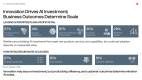
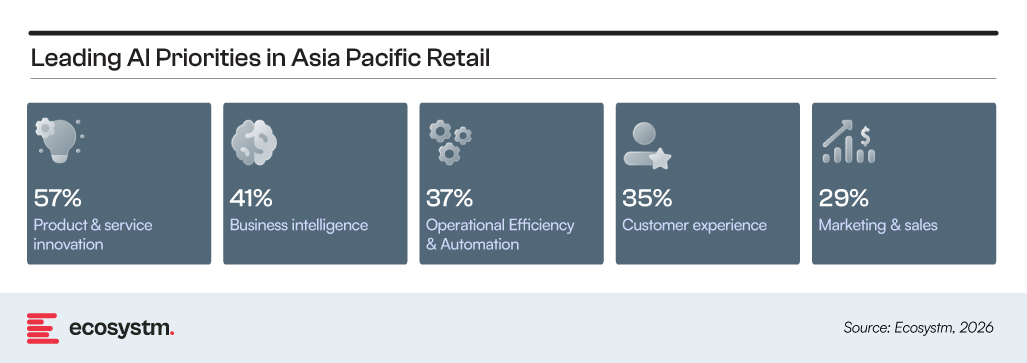
Retailers are making deliberate choices about where AI can create the greatest strategic value. While AI is being applied across multiple business functions, organisations see the greatest opportunity in developing new products, services, and business capabilities, supported by stronger data and analytics. Operational efficiency and customer experience remain important but are currently secondary investment priorities.
How retailers evaluate AI tells a different story. Innovation may secure initial funding, but productivity, cost reduction, and customer satisfaction determine whether AI becomes part of day-to-day operations.
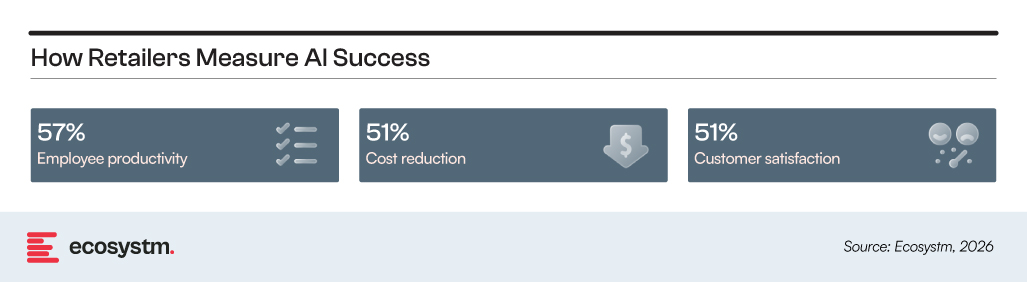
Asia Pacific retailers invest in AI to create new opportunities but continue investing only when those initiatives demonstrate measurable business value. Retailers should define success measures before deployment, build them into the business case from the outset, and use them to evaluate which initiatives should be expanded, refined, or discontinued. This creates a clearer path from innovation to operational adoption and helps ensure AI investment is guided by business outcomes rather than individual use cases.
4. AI Platforms Are Becoming the Foundation for Retail Scale
Many of the largest investments are focused on enterprise platforms rather than individual AI applications. Rather than deploying AI use case by use case, leading retailers are consolidating data, governance, and AI capabilities onto common technology foundations that support multiple brands, business units, and customer channels, treating AI as core infrastructure rather than a layer added on top of existing systems.
Wesfarmers is embedding AI across Kmart, Bunnings, Priceline and other businesses to optimise supply chains, automate workflows, and improve overall customer experiences, applying a single AI strategy across a portfolio of otherwise distinct retail brands. Hong Kong-based retailer AS Watson is taking a similar approach at even greater scale, extending AI across its O+O (offline-to-online) retail business to support customer engagement, store operations, analytics, and employee productivity across 12 retail brands.
This shows a broader recognition that AI depends on enterprise capabilities rather than a few use cases. Common platforms simplify governance, improve consistency, and make new AI capabilities easier to deploy across the organisation; and reduce the risk of each brand or business unit building its own disconnected AI stack, with its own data standards, governance model, and vendor dependencies. For multi-brand retailers in particular, this shared foundation is what allows a capability proven in one business unit to be extended to others without being rebuilt from scratch.
5. AI Adoption Depends on Organisational Capability
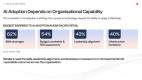
As retailers expand AI across the business, organisational capability is becoming a key factor in how quickly initiatives progress beyond experimentation and into broader adoption.
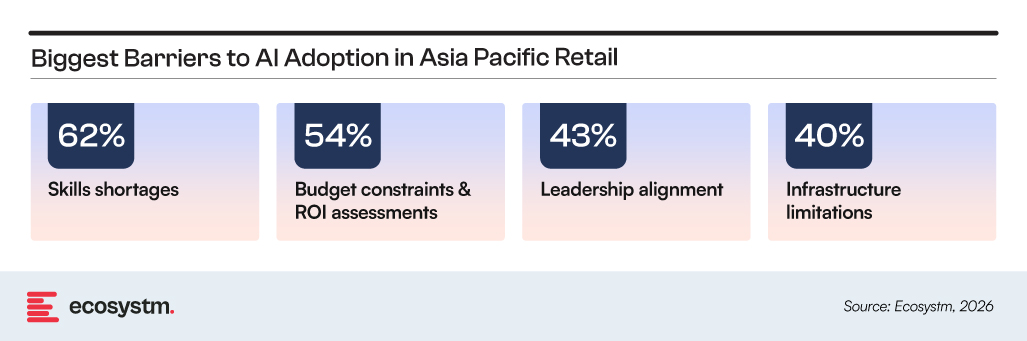
While infrastructure remains an important consideration, many retailers already have access to the underlying technology platforms needed to begin experimenting with AI. Many have invested in these during their recent transformation journeys. The harder challenge is building the organisational capability around it – developing the skills, aligning business leaders, and establishing a clear view of where AI can deliver measurable value. As AI expands across functions, such as merchandising, operations, marketing, and customer service, adoption depends on the ability to integrate AI into existing ways of working rather than simply deploying new technology.