Every week seems to bring another announcement from Malaysia: a new semiconductor initiative, an AI programme, a cyber law, a digital infrastructure investment, or an international technology partnership. On their own, they look like the steady rhythm of government policy. But a broader national strategy is taking shape. Malaysia is strengthening the building blocks of its future economy through digital infrastructure, advanced manufacturing, governance, skills, and sovereign technology. These initiatives point to a long-term effort to develop the institutions, industrial base, and technology ecosystem needed to compete in an AI-enabled world.
The Malaysia Digital Action Plan 2030 (MD2030), launched under the Towards an AI Nation 2030 agenda, provides the overarching framework. It sets a target for the digital economy to contribute 30% of GDP by 2030, supported by initiatives spanning digital government, cybersecurity, infrastructure, innovation, and workforce development.
The pattern is evident across recent announcements. New initiatives in semiconductors, sovereign AI, digital identity, connectivity, and workforce development all reinforce the direction set out in MD2030, indicating a consistent approach across multiple parts of government.
This offers greater clarity to businesses and investors about where national effort is being directed. As policy, funding, and industry initiatives reinforce one another, organisations are better placed to make longer-term decisions around investment, partnerships, and technology adoption.
Five themes stand out from the latest headlines.










1. Building the Infrastructure Behind an AI Nation
Malaysia’s AI ambitions are supported by significant investment in the physical and digital infrastructure required to develop and deploy AI at scale.
SemiconStart Malaysia, announced under Budget 2026, is designed to develop domestic semiconductor startups through mentoring, investor access, and prototyping support. The Malaysia Advanced Packaging Consortium (MAPC) is investing USD39 million to strengthen capabilities in advanced chip packaging, an important part of the AI semiconductor value chain as demand grows for higher-performance processors.
Private sector investment is reinforcing these efforts. AT&S’s planned investment of up to USD 2.3 billion in Kulim, driven by demand from AI infrastructure customers including AMD, demonstrates growing international confidence in Malaysia’s semiconductor ecosystem and its role within global AI supply chains.
The infrastructure strategy goes beyond chips. The SALAM undersea cable project will strengthen connectivity between Peninsular Malaysia, Sabah, and Sarawak, improving the network capacity needed to support cloud services, AI applications, and digital government nationwide.
There is a clear recognition that AI competitiveness depends on compute capacity, connectivity, cloud infrastructure, and efficient digital platforms forming the foundations on which AI ecosystems are built.
2. Sovereignty is Becoming a Strategic Capability
Technology sovereignty is a clear theme across Malaysia’s AI agenda. Recent initiatives focus on strengthening national control over the technology, infrastructure, data, and engineering capabilities that underpin AI, reducing dependence on external providers in strategically important areas.
YTL AI Labs’ ILMUchat provides organisations with a sovereign LLM designed around Malaysia’s languages and cultural context, offering an alternative for sectors that require stronger control over data residency and governance. Prime Minister Anwar Ibrahim’s directive that future government digital services be developed in-house reflects a broader commitment to strengthening domestic engineering capability while retaining ownership of source code and critical digital platforms.
This is reinforced by MOSTI’s proposed National Technology Sovereignty Framework, which aims to strengthen resilience by reducing dependence on external technologies in strategically important areas. Similar priorities are also evident at the state level, with Sarawak investing in satellite capability and AI infrastructure to support regional digital development.
Technology sovereignty is becoming a practical capability rather than an abstract policy objective. Building domestic capability across platforms, infrastructure, data, and engineering is strengthening Malaysia’s capacity to shape and sustain its own digital future.
3. AI Governance Framework Taking Shape
Malaysia is also strengthening the governance frameworks needed to support trusted deployment.
The proposed Cybercrime Bill replaces legislation introduced almost three decades ago, expanding legal protections to address AI-enabled threats such as synthetic media, identity theft, and increasingly sophisticated cybercrime. MY-AI standards establish clearer expectations around responsible AI development, providing organisations with guidance on issues including transparency, deepfakes, and trustworthy AI.
Trust is also being reinforced through digital identity. Enhancements to MyDigital ID introduce biometric verification and continuous identity validation, strengthening confidence in digital government services and online transactions while providing a more secure foundation for AI-enabled services.
AI adoption depends on confidence as much as capability. Governance, identity, and cybersecurity create the operating environment within which AI can be deployed more broadly across government and industry.
4. Skills are Being Developed at National Scale
Malaysia’s workforce strategy aims to broaden access to AI capability, extending opportunities beyond major cities, technical specialists, and new workforce entrants.
The 1Prompt Engineer, 1NADI initiative places certified AI trainers in community centres across the country, extending AI capability beyond major urban centres and improving access to practical skills. The government’s commitment to retrain 700,000 workers by 2030 reflects a similar focus on preparing the existing workforce for changing job requirements as AI adoption accelerates.
AI is also being applied within education itself. UNICEF and the Ministry of Education’s AI-powered Early Warning System (SiPKPM), now operating across more than 10,000 schools, helped return over 9,000 at-risk students to education during 2025, providing one of the clearest examples of AI already delivering measurable public-sector outcomes.
Workforce development is being treated as core national infrastructure, expanding AI capability across communities, industries, and public services.
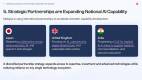
5. Strategic Partnerships are Expanding National AI Capability
Malaysia’s international partnerships complement its domestic priorities.
Collaboration with Japan spans semiconductors, AI, and quantum technologies, supported by discussions around a National Quantum Council and IBM’s plans to expand quantum operations from Malaysia. Partnerships with the United Kingdom focus on AI, cybersecurity, sustainable data centres, and digital trade, reflecting shared interests in digital infrastructure and trusted technology.
Malaysia is also strengthening AI cooperation with India through a proposed Centre of Excellence for Applied Artificial Intelligence in Johor, creating a platform for applied AI research, technology commercialisation, and executive education while supporting domestic capability development.
The partnership strategy is diversified. By working across multiple technology leaders and sectors, Malaysia is reducing dependence on any single ecosystem while expanding the resources available to support its long-term AI ambitions.
Ecosystm Opinion
Most countries now have an AI strategy. The differentiator is whether that strategy is reflected in decisions about infrastructure, industry, regulation, skills, and public investment.
Malaysia’s recent initiatives suggest an approach that treats these elements as interconnected rather than independent. Semiconductor capability supports AI infrastructure. Digital identity and cybersecurity strengthen trust. Skills programs expand the talent pipeline. Sovereign AI and cloud investments increase national capability. Each initiative reinforces the others.
Whether this translates into sustained economic and competitive advantage will depend on execution over the next few years. What is already becoming clearer, however, is that Malaysia is positioning AI as part of a broader economic and industrial strategy.